

The right cup for herbal tea depends first on where you plan to brew it. If dried leaves, flowers or fruit pieces will steep inside the cup, you need space for the ingredients and a practical way to remove them. If you brew separately and strain before serving, the drinking cup does not need to hold an infuser at all. A ceramic tea cup can suit that second arrangement without being described as an all-in-one brewing mug.
This distinction matters when shopping. A photograph of a beautiful cup beside loose flowers does not show that the cup includes a filter, has enough room for your usual recipe, or comes with a lid. Start with the preparation you actually use, then compare serving volume, grip, rim and cleaning access. The result may be a roomy infuser mug, a glass brewing vessel with separate cups, or a teapot you already own paired with a new drinking cup.
Choose between brewing in the cup and serving into it
One vessel: a cup or mug with a removable infuser
An infuser mug combines a drinking vessel with a removable basket. It is useful when you want one full serving beside you and do not want to pour from another vessel. Check that the basket fits securely, sits low enough for the intended water level, and can be lifted out without awkwardly reaching through steam.
Commercial examples such as Tea Forté's ceramic steeping cups explicitly identify the cup and integrated infuser as components of the design. That is a different product category from a plain ceramic cup. With any listing, read the included-items description rather than assuming that everything shown in a lifestyle photograph is supplied.
Two stages: brew first, then pour into a drinking cup
A separate brewing vessel gives the ingredients room while the cup holds only the finished infusion. A strainer or removable basket keeps most solids out of the drink. This arrangement is particularly practical when several people share one batch or when you prefer a modest serving followed by refills.
A small handleless cup belongs in this serving role. It does not need to contain the entire batch or accommodate a large flower head. The trade-off is simple: there is another vessel to wash, and you need a safe place to set it between pours. If you want a large drink with no refilling, a larger mug may be the more suitable purchase.
Match the filter to the ingredients, not just the cup
“Herbal tea” covers many mixtures. A blend containing fine rooibos particles presents a different filtering problem from large mint leaves or whole flowers. A basket that looks roomy can still let small fragments pass, while a compact tea ball may be inconvenient for bulky ingredients.
Look at the actual dry blend before choosing an accessory. Is it mostly large pieces, a mixture of sizes, or fine material? For blends with fine particles, consider a suitably fine filter and check how easily it can be rinsed. No filter photograph alone establishes that the finished drink will be completely free of sediment.
For larger leaves and flowers, prioritize a brewing space that accommodates the package's recommended quantity without packing the ingredients tightly. You do not need to force every ingredient into the drinking cup. A separate pot and strainer can solve the space problem while leaving you free to choose the cup for its shape and appearance.
| Your usual preparation | Practical arrangement | Check before buying |
|---|---|---|
| A bagged herbal blend, one full serving | A cup or mug sized for the stated brewing water volume | Usable fill level and a place for the removed bag |
| Loose leaves or flower pieces | A roomy removable basket or separate brewing pot | Ingredient space, secure fit and easy removal |
| A blend containing fine particles | A suitable fine filter followed by a drinking cup | Mesh suitability and cleaning access |
| Large whole flowers or a display-focused preparation | A suitably sized transparent brewing vessel | Room for the ingredient and a clear viewing area |
| Sharing a strained batch | A serving vessel and separate ceramic cups | Comfortable portions, refills and enough cups |
These are arrangements rather than fixed recipes. Use the particular blend's package directions for quantity, water temperature and steeping time. A flower-and-fruit mixture and a mint blend do not automatically need identical preparation simply because both are sold as herbal tea.
Buy for your drinking portion, not an imagined universal size
Before choosing a cup, measure the amount you normally want at one time. Someone who carries one large mug to a desk has a different requirement from someone who pours several smaller portions during a conversation. Neither habit is a reason to buy a cup that is inconvenient for the other.
For brewing directly in a mug, account for the space occupied by the basket and ingredients. A listed brimful capacity is not the same as a comfortable working fill with a filter inside. Ask whether a quoted volume describes the empty vessel filled to the rim or a practical serving level.
For separate brewing, the total batch can exceed one cup's serving volume. As a planning example, a 300 ml batch divided into three 100 ml portions requires refilling or three cups; it does not require each cup to hold 300 ml. Those figures illustrate the arithmetic only and are not specifications for the featured product.
Our tea cup capacity chart covers ml and oz comparisons. For a particular product, use confirmed measurements rather than estimating capacity from a hand-held photograph or a wide-looking opening.
Ceramic or glass: choose for the view and the routine
A transparent vessel is useful when seeing the ingredients is part of the experience. It lets you watch a flower arrangement and see the liquid from the side. An opaque ceramic cup cannot provide that view, even if the cup itself has a floral pattern. For a display-focused preparation, keep the transparent brewing vessel and use separate cups only when you want to serve.
Ceramic offers a different visual choice: the interior color and glaze become the background beneath the drink. A pink interior, dark patterned bowl and plain white cup will not present the same appearance. If comparing the liquid's color is important, use consistent cups under similar lighting rather than judging one serving against several different glazes.
Do not turn a material preference into a universal performance claim. Wall thickness, shape, serving volume and whether there is a lid all affect the practical setup. Check the actual product's care and appliance permissions. The words “ceramic” and “glass” alone do not establish microwave compatibility or a particular heat-retention time. See our ceramic and glass teacup comparison for the broader choice.
Blush Pink: a drinking-cup example for a strained infusion

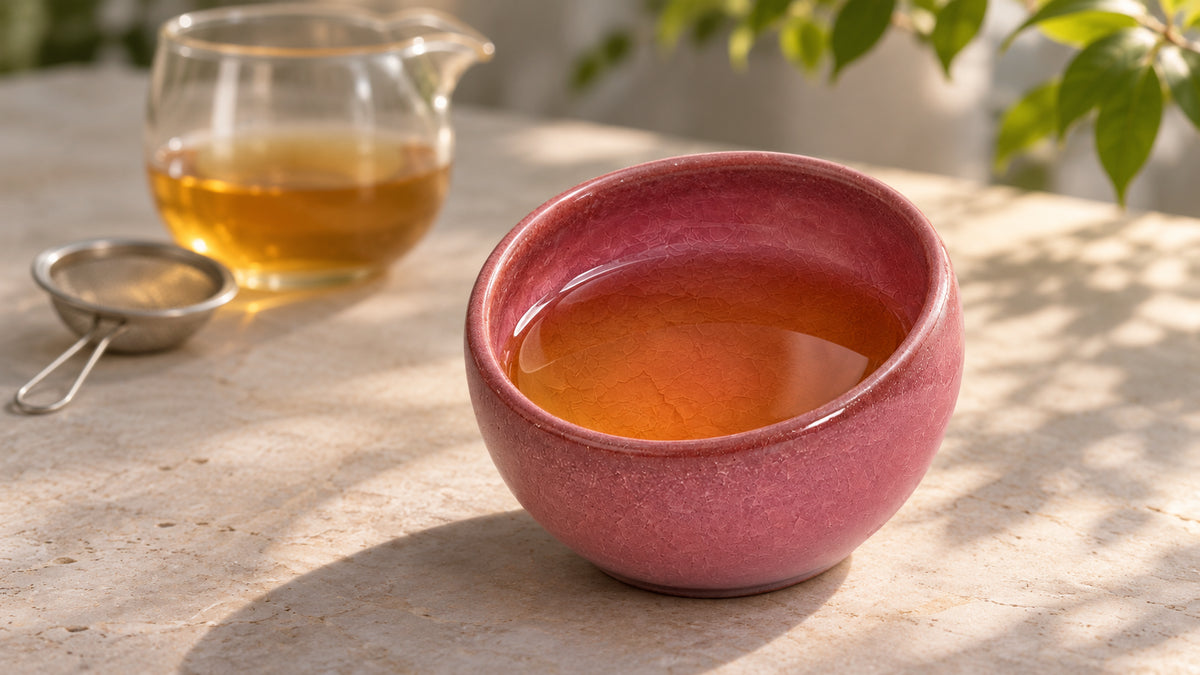
The Blush Pink Ceramic Tea Cup has a rounded, handleless body with a rose-pink interior and exterior. Fine irregular lines are visible across the surface, with a darker foot beneath the bowl. Its role in this setup is to receive an already prepared, strained drink.
Choose it for the pink color and bowl profile if those suit your table. Do not choose it expecting an included filter or lid: the cup is not presented here as an infuser-mug system. Confirm capacity and dimensions before buying if you need a precise serving size. We are not adding an unverified volume, box inclusion or appliance rating to the product in this article.

The article's header is an AI-generated serving scene based on this cup. The pitcher and strainer in that scene illustrate separate brewing and serving; they are not a statement of included accessories. The original product photographs above are the references for the cup itself.
A practical sequence for serving herbal infusions in ceramic cups
- Read the blend's preparation directions. Set the quantity and water volume for the actual recipe rather than using the drinking cup as an uncertain measuring tool.
- Choose the brewing vessel and filter. Make sure the ingredients have suitable space and that the filter matches their particle size.
- Prepare a resting place for wet accessories. Set out a suitable dish for a removed basket or bag before handling hot liquid.
- Separate the drink from the ingredients at the stated time. Remove the basket or strain into a suitable serving vessel instead of leaving a loose blend in every cup.
- Pour manageable portions. Leave space below the rim and wait until the cup and drink can be handled comfortably before lifting or sipping.
- Keep the remaining batch separate for refills. Avoid repeatedly dipping a drinking cup into the brewing vessel.
This routine does not require a complete matching set. A brewing pot already in your kitchen, a compatible strainer and one ceramic cup may be enough. If you primarily use bags in a teapot, our article on using tea bags in a teapot covers that specific preparation.
Five questions to ask before ordering
- Am I buying a brewing vessel, a drinking cup, or a system that explicitly includes both cup and filter?
- Does the confirmed serving volume fit my usual portion without filling to the rim?
- If I brew inside it, will the basket fit securely and leave room for this blend?
- Can I grip the cup comfortably, and do I prefer a handle for my routine?
- Are the care requirements and included items stated clearly for the exact product?
Also consider cleanup. A removable basket is useful only if you can empty and rinse it conveniently. Strongly scented blends make thorough washing relevant when you switch drinks. Follow the product's care requirements instead of assuming that any glazed finish is stain-proof or that every component can go in a dishwasher.
Common questions about cups for herbal tea
Can I drink herbal tea from a ceramic tea cup?
A ceramic cup intended for drinking can serve a prepared herbal infusion within its stated use conditions. For a plain cup, the simplest arrangement is to brew and filter separately. Confirm product-specific suitability rather than relying on color, glaze name or decorative style.
Do I need a lid on the drinking cup?
Not necessarily when it receives a finished drink. A lid may be part of the brewing arrangement when the blend's directions call for covering. It is not a reason to assume that a separate handleless cup comes with one.
Is a small cup suitable for whole flowers?
It can hold a portion of the strained infusion, but that does not make it the right place to steep the flowers themselves. Use an appropriately sized brewing vessel when the ingredients need more room. Choose transparent ware if viewing the flowers is your main priority.
Should I buy a special cup for each herbal blend?
Start with differences that affect preparation: ingredient size, filter needs and serving amount. One well-chosen drinking cup can receive different strained drinks. Extra cups are more useful when you need simultaneous servings or prefer different sizes, rather than because each ingredient requires a decorative theme.
Compare our tea cups after deciding how you will brew and how much you want to drink at once. Choose a practical infuser mug for one-vessel preparation, or a ceramic drinking cup such as Blush Pink for a separate serving arrangement. The important match is between the cup and your routine, not between a product name and an assumed brewing function.
Share:
Tea Cup Foot Rings: Why Is the Base Unglazed?
Built-In Teapot Strainers vs Removable Infusers