

A ceramic tea cup can be glossy inside and around its walls yet have a plain clay-colored ring underneath. That contrast is often intentional. The contact area at the base is commonly left free of glaze so the cup can rest on a kiln shelf or setter without the glaze bonding it to that support during firing. A bare foot is not, by itself, a defect. It also does not prove that a cup is handmade, authentic, non-slip, or certified for a particular use.
For someone buying a handleless tea cup online, the useful questions are more specific: which part actually touches the table, does the cup rest evenly, and what do the photographs show about the transition from glaze to clay? A beautiful interior photograph cannot answer all three. An underside photograph and a low side view give you a much better basis for choosing.
What is the foot ring on a tea cup?
The foot ring is the circular raised support beneath a cup or bowl. When the cup is upright, its lowest contact edge rests on the table. The area inside the ring may be recessed, while the outside of the foot rises toward the glazed wall. These are separate surfaces, even when they appear as one brown patch in a small product photograph.
Not every ceramic cup has the same construction. Some have a broad, relatively flat base; others have a distinct short foot or a deeper recessed underside. A ring does not have to be tall to be visible. Its shape affects the cup's appearance in profile, but a photograph alone cannot establish how it was formed or finished. Digitalfire's foot-ring reference describes the distinction between a raised foot and a flat-bottomed container.
Keep the rim diameter and foot diameter separate when comparing listings. The rim tells you about the opening at the top. The foot's outside diameter concerns the bottom support and its fit on a resting surface. One measurement cannot substitute for the other, and neither confirms the cup's usable capacity.
Why is the bottom left unglazed?
During firing, glaze develops into a glassy coating. Where that coating contacts the firing support, it can adhere to it. Leaving the relevant contact area free of glaze is a common practical solution. Holst Porcelain describes removing glaze from the foot ring to prevent this bonding in its manufacturing explanation. That explains a general production reason, not the exact firing history of every cup sold online.
The visible bare area can extend beyond the narrow edge that touches a table. You may see an exposed band up the outside of the foot, a recessed clay-colored center, or a combination of these. Consequently, “unglazed bottom” does not always mean one identical shape or amount of exposed clay.
It also does not mean the cup is unfired. Glaze coverage and firing are different matters. Nor does a bare underside turn a cup with a glazed drinking interior into fully unglazed teaware. If you are choosing between those broader categories, our article on glazed and unglazed teaware addresses the drinking surfaces rather than just the support underneath.
A real example: the Glacial Blossom cup

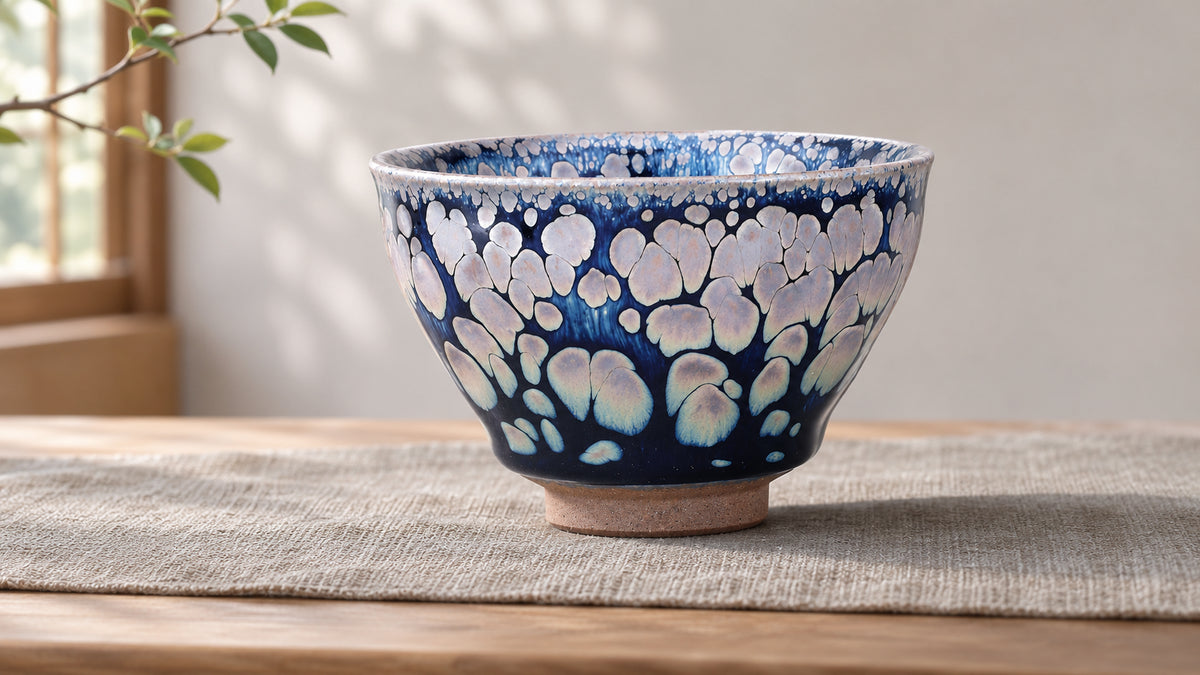
The Glacial Blossom Blue-and-White Ceramic Tea Cup has a handleless form, dark blue glaze and pale petal-like markings. In the side photograph, a pink-brown foot is visible below the patterned wall. This makes it a useful visual example of a glazed cup with a contrasting exposed base.

The underside photograph shows more than the front image: a circular outer contact edge, a recessed center and the boundary where the dark glazed wall meets the clay-colored base. The matte-looking finish contrasts with the glossy body. Those are visible details, not evidence of a particular clay recipe, firing temperature, absorption rate or manufacturing method.
Use the two views together. The side view shows how much foot is visible while drinking; the inverted view shows the support structure. The scene image at the top of this article is an AI-generated setting based on this product. The two images above are the original product photographs and are the relevant references for inspecting the base.
What bottom photographs can and cannot tell you
| Detail in the image | Useful observation | Still needs confirmation |
|---|---|---|
| Circular raised edge | Location and general shape of the foot | Exact diameter, even contact and stability |
| Clay-colored band below the glaze | Visible contrast and extent of the exposed area | Body composition and absorption |
| Recessed center | Difference between the center and resting edge | Recess depth and cleaning access |
| Stamp or mark | Presence and visible appearance of a mark | Maker attribution and provenance |
| Close-up of the contact edge | Visible chips, particles or irregularities | Texture to the touch and condition of the shipped cup |
A missing bottom image is a reason to ask for one, not automatic evidence of poor quality. Equally, a clean-looking studio image is not a guarantee that the particular cup delivered will feel identical. A representative photograph should be accompanied by clear answers about any details important to your purchase.
Four checks before buying a cup with a bare foot
1. Request an underside view and a low side view
Ask for a photograph taken directly toward the inverted base and another taken near table height with the cup upright. The first separates the contact ring from the center; the second shows the foot's proportions beneath the wall. A close-up cropped tightly around a stamp may omit the very edge you need to inspect.
If you are comparing several pieces, ask whether the gallery represents a typical example or the exact cup being sold. Do not treat shadows as measured recess depth or a reflection as a chip. A second angle is often more useful than magnifying one ambiguous image.
2. Ask about the contact edge, not just the color
The practical question is whether the resting edge is intact and free of loose grit or sharp damage. “Brown base” and “smooth base” describe different things. A photograph can show an obvious missing section, but it cannot reliably convey fine texture. Ask the seller about the contact surface if your table has a delicate finish.
Request clarification rather than assuming that every visible variation is a fault or every irregularity is desirable craftsmanship. A documented design feature and accidental damage are not interchangeable. A premium pattern on the wall does not remove the need to check the underside.
3. Confirm the support dimensions when fit matters
If the cup must sit inside a particular saucer well or on a small coaster, ask for the outside diameter of the foot. State explicitly that you do not mean the rim. Leave room around the support rather than relying on two nominal dimensions being exactly equal.
For a desk setup, consider the entire arrangement: room for setting the cup down, distance from a keyboard and a stable resting surface. A small contact area is not automatically unsuitable, and a wide one is not a guarantee against tipping. The cup's overall form, contents and how it is handled also matter. Our article on saucers, coasters and handleless cups covers those resting accessories in more detail.
4. Keep use claims separate from the base design
Food-contact suitability, dishwasher compatibility, microwave use and direct heat are product-specific questions. Neither an exposed ring nor a glazed center answers them. Ask for the seller's stated use conditions and supporting information where relevant. Do not infer a heating permission from the appearance of fired clay.
For Glacial Blossom, the photographs support the visual comparison in this article. We are not assigning an unverified capacity, size, gift-box inclusion or appliance rating to it here. Those details should come from a confirmed listing or a direct answer, rather than a calculation from the image.
When the cup arrives: check it before the first pour
Inspect the empty cup in good light. Look around the rim, wall and foot for shipping damage, and compare the underside with the listing. Set it gently on a clean, level, suitable surface. If it rocks noticeably, first make sure neither the surface nor the foot has debris on it. Do not use a freshly filled cup of hot tea to test an uncertain base.
Report a chipped contact edge, loose particles or persistent rocking to the seller with clear photographs. Do not sand, grind, seal or coat the underside as a first response. Those changes may alter the piece and complicate a condition assessment. A product should not require an improvised repair to match what was sold.
For routine handling, lift the cup instead of dragging it across a table. Keep both the foot and resting surface clean. On a surface you want to protect, choose a stable coaster or mat appropriate for that surface and for hot drinkware. A protective accessory is not a repair for a damaged cup and does not make every table finish immune to marks.
Follow the maker's care directions, including drying and appliance restrictions. A wet ring left after washing is not, on its own, a useful home measurement of absorption or a reason to coat the foot. If the base shows a persistent unexpected change, stop guessing from color alone and ask the seller about that specific piece.
Common questions about unglazed tea cup bottoms
Is an unglazed foot ring a defect?
No. A deliberately bare contact area is common in glazed ceramics. Evaluate condition and performance separately: intact edges and an even resting position matter more than whether every visible surface has the same gloss.
Does a bare foot mean the whole cup is unglazed?
No. A cup may have a glazed drinking interior and exterior walls while its base remains exposed. When comparing teaware materials, check the surface that contacts the tea as well as the underside.
Does it prove a cup was made by hand?
No. Exposed bases occur in different production methods. A stamp, rough texture or concentric ring is not sufficient evidence of a named maker, age or hand-forming method. Those claims need separate provenance.
Should every cup have a tall foot?
No. Low feet, deeper rings and flatter bases are different designs. Choose a cup whose proportions and resting arrangement suit your setup, and confirm any dimensions needed for a precise fit. Height alone is not a quality grade.
Can an unglazed foot scratch a table?
A hard contact edge or trapped grit can mark a vulnerable surface, especially when dragged. Inspect the cup, keep the resting area clean and lift rather than slide it. Use suitable protection when needed; do not assume that any ceramic base is universally scratch-proof.
Choose from the bottom as well as the top
When comparing ceramic tea cups, save the appealing interior view, then look for the underside. Match the foot's visible shape to your resting surface, ask for missing measurements and separate appearance from verified specifications. The Glacial Blossom cup's original gallery supplies both front and bottom views for that comparison. A clear base photograph will not answer every question, but it helps you ask the right ones before the cup reaches your table.
Share:
Tea Bowls vs Rice Bowls: What Changes at the Table?
Tea Cups for Herbal Infusions: Choosing for Leaves and Flowers