

A teapot can drip because a thin film of water follows the underside of its spout instead of falling into the cup. But not every wet table comes from that effect. Water may escape around the lid, the flow may falter when a passage is obstructed, or liquid may be leaking through damaged ceramic. The useful first question is not “Is this a bad teapot?” It is “Where does the water first appear?”
Start with a cool, empty pot and room-temperature water. A controlled check over a sink separates pouring behavior from tea leaves, high fill levels and damage, without experimenting with hot tea. Watch the first wet spot, change one thing at a time, and stop if the pot is chipped, cracked or difficult to hold securely.
First, separate a drip from an overflow or a leak
A bead remaining under the spout after you finish pouring is different from a ribbon of water running down its exterior throughout the pour. Both are also different from water appearing at the lid seam. Before blaming the spout, dry the outside and check the pot while it stands upright. Water left over from rinsing can otherwise make a sound vessel look as though it leaks.
The table below gives starting points, not a diagnosis of every pot. Several causes can occur together. A lower fill may reduce lid overflow while an occasional bead still remains under the spout.
| What you see | What to check | A safe first step | When to stop |
|---|---|---|---|
| One bead after the pour | Liquid remaining on the spout edge | Observe the finish with cool water over a sink | The edge is chipped or sharp |
| Water tracks underneath the spout | Spout edge, wet exterior and pouring behavior | Dry the exterior and compare a comfortable, steady pour | Avoiding it requires an unstable grip or abrupt movement |
| Water comes from the lid seam | Fill level, lid seating and tilt | Reduce the fill and reseat the lid while everything is cool | The lid does not sit securely |
| Flow pulses or becomes weak | Leaves, a fitted filter or an accessible air opening | Empty and gently rinse accessible passages | A blockage cannot be removed without force |
| Water appears while the pot stands upright | Residual rinse water or a possible body leak | Dry the outside and observe on a waterproof surface | Seepage continues or damage is visible |
Why water sometimes follows the spout
The “teapot effect” describes liquid turning around a pouring edge and running along the outside rather than separating into a clean stream. Research reported by TU Wien connects this behavior to the interaction between liquid motion, wetting and forces at the edge. Under some conditions, a slow flow allows liquid to follow the underside.
That does not mean “pour as fast as possible.” A sudden, forceful pour can miss the cup or dislodge a loose lid. It means a hesitant trickle is not automatically the tidiest option. A controlled, continuous pour is worth comparing with your usual motion, using cool water and a wide receiving vessel.
A photograph cannot establish how reliably a particular spout separates the stream. Its edge, the surface and the actual pouring conditions all matter. A dramatic pointed spout is not proof of drip-free performance, and a small ceramic brewing pot is not automatically faulty because a drop remains at the end.
A room-temperature water check, one change at a time
1. Set up without hot water or tea leaves
Place a stable bowl in the sink, leaving enough room to move the pot without striking a hard surface. Check that the pot, handle, lid and spout are intact. Dry the outside with a soft cloth. Add room-temperature water to a modest level below the lid opening rather than filling to the brim. Leave tea leaves, tea bags and optional accessories out of this first comparison.
Use the pot's normal grip. If you cannot manage its weight and lid comfortably, do not compensate by gripping the spout or pressing a finger over an opening. Keep children and pets away from the test area. The point is to observe a normal action, not force the vessel through an extreme angle.
2. Watch where the outside first becomes wet
Pour gently into the bowl while looking at the spout and lid seam. Does the stream travel into the bowl before a final bead forms? Does it curl underneath immediately? Does water first appear near the lid and then travel down the body? If someone records a short side-view video, it can be easier to separate these events afterward.
Return the pot upright smoothly. Do not flick the wrist to throw off the final drop. Allow any remaining bead to fall over the sink before setting the pot down. Note whether the problem happened at the start, during the main flow or only at the finish.
3. Compare a lower fill
Repeat with less water, keeping your grip and receiving bowl the same. If water around the lid disappears, fill level or the amount of tilt may be involved. This is different from a spout defect. A stated capacity is not necessarily a comfortable serving fill, particularly once leaves or a bag take up room.
There is no universal percentage that suits every teapot. Start below the opening and adjust within the maker's stated limits. The useful result is whether a practical serving amount pours comfortably, not whether the pot can be filled to its maximum and tipped without a drop escaping.
4. Compare a steadier motion
Keep the lower fill and try a smooth, continuous tilt instead of repeatedly starting and stopping. Stay close enough to the bowl to control the landing point. There is no single correct angle for all handles and spouts. Never tip farther or faster than feels secure merely to produce a cleaner-looking stream.
If the pot only behaves acceptably with an awkward grip, that is a useful finding. It may not suit your hands or serving routine. A cloth can protect the table from a minor finishing drop, but it should not become a workaround for an unsafe pour.
Check leaves, filters and air passages separately
A water-only check that pours smoothly does not prove the same result with a full load of leaves. After brewing, leaves may gather near the spout entrance or a filter. If flow changes only when tea is present, empty the cooled pot and look at the accessible outlet area before judging the spout shape.
- Remove loose leaves and rinse gently. Do not push debris deeper into a narrow passage.
- If the pot has a removable filter, clean and reseat it according to its care information.
- If there is an accessible lid vent, check for visible residue without enlarging or scratching the opening.
- Check that a tea bag or string is not caught where it interferes with the lid or outlet.
Air needs a route into a pot as liquid leaves, but designs provide that route in different ways. Do not assume every teapot has a visible lid hole. Do not drill one, use a metal pin to alter it, or pour hot tea with the lid perched loosely to compensate. Ask the seller about the design if the airflow path is unclear.
For tea bags specifically, our article on using tea bags in a teapot covers placement and removal. Keep brewing choices separate from the initial water-only check so you can identify what actually changed.
Snow Flow as a small ceramic teapot example
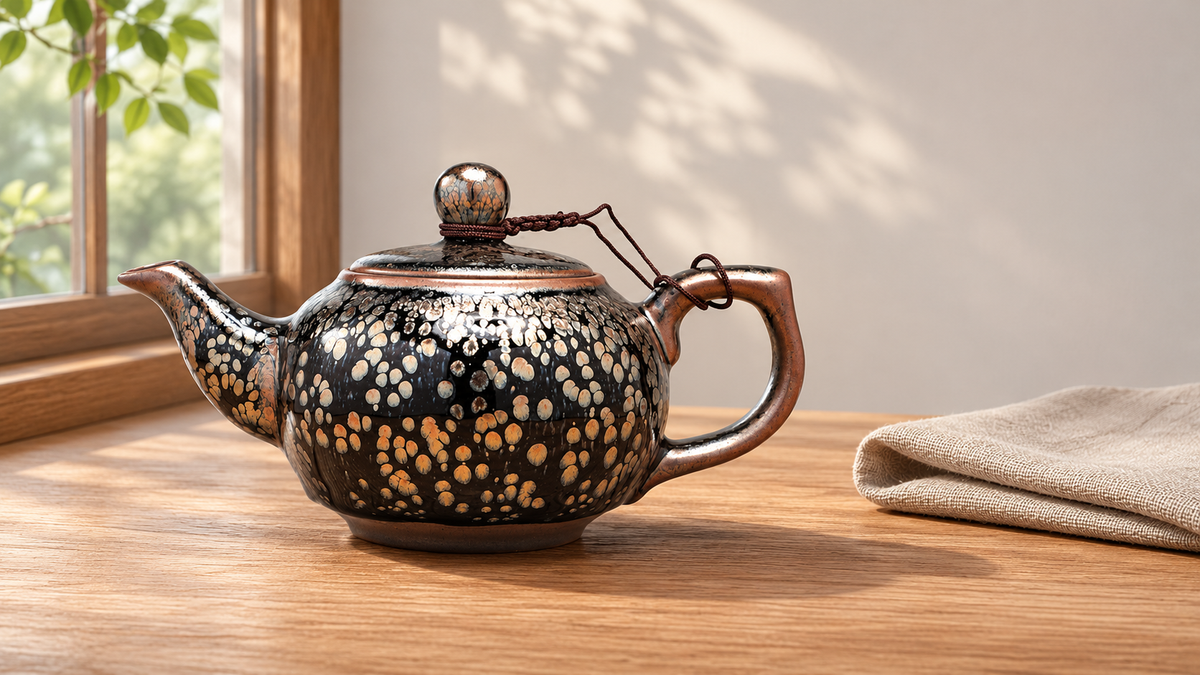
The Snow Flow Tenmoku Ceramic Teapot is listed at 200 ml. Its product photographs show a rounded dark body with contrasting pale spots, a separate fitted lid and a side handle. It is a useful example of the compact brewing-pot format discussed here, rather than a large vessel for filling several mugs.

The listed capacity helps you judge serving scale, but it does not establish a tested working fill or a drip-free claim. We have not performed a pouring test on this product for this article. The photograph shows the vessel's appearance; it is not evidence of its flow rate, lid seal or performance at different fill levels.
When choosing any ceramic brewing pot, consider where you will pour. A broad receiving pitcher offers a different target from a small cup. You should not need to hold the pot unusually high to reach the vessel. For serving combinations, see pairing teacups with teapots. Treat a brewing teapot as separate from equipment used to boil water; do not place it on a stove unless the manufacturer explicitly rates that exact product for the heat source.
What not to do to a dripping ceramic spout
Do not sand, file or grind the lip to imitate a sharper edge. Altering the ceramic or glaze can create damage and sharp surfaces. Do not apply household water-repellent sprays, glue or improvised coatings to an area that touches the drink. Food-contact suitability cannot be assumed from a general claim that a substance repels water.
Adding oil or butter is not a sensible routine remedy for tea service. It introduces residue and can affect the drink and cleaning. Avoid rapid wrist snaps, plugging openings with a finger, or increasing water temperature as an experiment. None of those actions is needed to establish where a leak starts.
If the pot develops a crack, a loose handle or unexplained seepage through the body, stop using it for hot drinks and contact the seller. A body leak is not the same problem as a small drop at a pouring edge. Do not try to make damaged drinkware usable with a home repair.
What to ask before buying a teapot
A pouring video can answer questions that a polished product photo cannot. Ask for a side view that shows the spout, lid and the end of the pour, rather than only a short clip of a stream already in motion. It is also helpful to know roughly how much water was in the pot and whether the demonstration used leaves.
Look for a grip you could realistically use, not just attractive glaze. Consider these points:
- Can the pot be held securely at the serving fill you expect to use?
- Does the lid stay seated during an ordinary pour?
- Can you see and clean the accessible outlet area without force?
- Does the receiving cup or pitcher fit comfortably below the spout?
- Does the seller distinguish nominal capacity from a demonstrated serving amount?
These questions help you compare usability without expecting every vessel to behave identically. Our broader article on choosing the right teapot covers material, size and brewing needs. Here, the priority is narrower: a manageable pour and a clear explanation when water goes somewhere unexpected.
Common questions about teapot drips
Does a drip mean the teapot is defective?
Not necessarily. A remaining drop at the spout can occur without a crack or broken part. Persistent leakage from the body, a damaged rim, or a lid that cannot sit securely needs a different response. Record the symptom and contact the seller rather than assuming all wetness has the same cause.
Should I pour more slowly?
Not automatically. A very slow trickle can allow liquid to follow the underside of an edge. Compare a comfortable, steady motion with cool water. Do not increase speed beyond your control or attempt to reproduce someone else's precise angle.
Will a lower fill fix it?
It can help distinguish lid overflow from spout dribbling, but it is not a universal cure. If the same underside trail occurs at several practical fill levels, document it and ask the seller about the particular pot. Do not keep lowering the fill until the vessel becomes impractical to use.
Is a drip catcher necessary?
A small cloth or suitable coaster can manage an occasional finishing drop on the table. It does not repair a crack or correct unstable pouring. Accessories fitted directly to a spout also need to suit its size and material; avoid anything that scratches, squeezes or stresses the ceramic.
The most useful outcome is a repeatable, comfortable serving routine. Locate the first wet spot, compare cool-water pours with one change at a time, and separate a minor finishing bead from overflow, obstruction or damage. Choose the next action from that observation rather than from a blanket promise that every drip has the same fix.
Share:
Can You Use Tea Bags in a Teapot?
Aroma Cups vs Drinking Cups: Do You Need Both?