

Yes, you can use tea bags in a teapot. Put the bags in a clean brewing pot, add the amount of hot water specified on the tea package, steep for the recommended time, and remove the bags before serving. An intact tea bag already contains the leaves, so a separate loose-leaf infuser is usually unnecessary.
The important distinction is between brewing in a teapot and heating water in a kettle. A ceramic brewing teapot belongs on a stable surface, not directly on a burner. Heat the water separately, then pour it into the pot. Our teapot and kettle comparison covers that difference in more detail.
A teapot can make a simple bagged-tea routine more pleasant, especially when you want several small pours rather than one large mug. It does not automatically improve the tea, however. Matching the bag to the water volume and taking it out on time matters more than buying an elaborate set.
How many tea bags should go in a teapot?
Start with the amount of water you will actually brew, not the number of cups pictured beside the pot. Tea bags vary in leaf weight and intended serving size. A regular cup bag, a larger pyramid sachet, and a pot-size bag are not interchangeable measures.
Read the water allowance printed on your particular tea package. If one bag is intended for 250 ml, two bags are a reasonable starting point for 500 ml. If another bag is intended for 500 ml, that same pot needs only one. The calculation changes with the tea, even though the teapot stays the same.
The table below is a worked example for a package specifying one bag per 250 ml. It is not a universal dosage chart. US fluid-ounce conversions are rounded, and all amounts refer to water added rather than the pot's advertised capacity.
| Actual brewing water | Approx. US fl oz | Bags in this example | Practical check |
|---|---|---|---|
| 250 ml | 8.5 | 1 | Leave room below the lid and for the wet bag. |
| 500 ml | 16.9 | 2 | Use a pot large enough for the water and both bags. |
| 750 ml | 25.4 | 3 | Allow space around the bags rather than packing a small basket. |
| 1,000 ml | 33.8 | 4 | Remove every bag when the steep is finished. |
Do not automatically add an extra bag “for the pot.” That tradition is not a substitute for the tea maker's stated ratio. Try the labelled proportion first, then adjust the next batch to your taste. For a quantity between the table's examples, following a smaller measured batch is often simpler than trying to divide a sealed tea bag.
Small cups do not each need their own tea bag
Imagine brewing 250 ml and sharing it in five small pours. You have still brewed 250 ml, not five mug-sized servings. The number of bags depends on that total water volume. Counting every little cup as a full serving can produce an unnecessarily concentrated pot.
It also helps to distinguish advertised capacity from usable brewing space. A pot described as 300 ml may not comfortably hold 300 ml of water plus a swollen bag beneath its lid. Check its fill level with cool water before the first hot brew, leaving enough space to close and pour without overflow.
How to brew tea bags in a teapot
Set out the teapot, a cup, a timer, and a small dish for the used bag before heating the water. Preparing a place for the wet bag avoids a hurried search while you are holding it above a hot pot.
- Check the pot and tea package. Use an undamaged pot intended for brewing hot tea. Note the bag-to-water ratio, temperature, and steeping time for your tea.
- Measure the water. Choose the quantity you intend to drink. You do not have to fill a large pot simply because it has spare space.
- Heat water separately. Use a kettle or another suitable water-heating vessel. Do not place a ceramic brewing teapot on a stove, hot plate, or open flame.
- Prepare the pot gently. Follow its care directions for warming. Avoid pouring very hot water into a chilled vessel or cooling a hot one abruptly. Empty any warming water before measuring the brewing water.
- Add the tea bags and water. Give the bags room to become wet and expand. Keep any paper tags outside the water, and avoid trapping strings so tightly that the lid sits unevenly.
- Time the steep. Start the timer when the tea meets the water. Seat the lid normally without blocking its vent or forcing it over a bag.
- Remove the bags and serve. Lift the lid carefully away from your face, remove the bags through the opening, and place them on the waiting dish. Pour slowly with a secure grip.
Keep fingers away from the hot water and steam. For a stringless bag, use a clean spoon or suitable utensil rather than reaching into the pot. Let the bag drain briefly; squeezing it hard is unnecessary and can tear the pouch or splash hot tea.
Temperature and steeping time come from the tea, not the pot
A ceramic pot does not make every tea a boiling-water, five-minute brew. A green tea bag and a breakfast black tea bag can have different requirements even when their outer bags look identical. Herbal blends vary too. Use the specific package's temperature and time as your starting point instead of borrowing a fixed routine from a different tea.
For example, if your package calls for three minutes, set a three-minute timer rather than waiting until the liquid looks dark enough. Colour is an unreliable measure across different teas. A pale infusion can already have a full flavour, while a dark one may still be weak because too much water was used.
If the first batch tastes too strong, change one variable at a time on the next brew. Keep notes on the water amount, number of bags, and steeping time. This makes it easier to repeat a result you enjoy without guessing whether the new pot, a different mug, or an extra minute caused the change.
Do you need an infuser for tea bags?
Usually, no. The bag acts as the leaf container. Placing an intact bag directly into the pot is different from pouring loose leaves into it: you can remove the whole pouch when the infusion is finished.
If your pot has a removable basket, a tea bag can sit inside it only when there is enough room for the bag to expand and for water to reach it. The basket must also reach the water at your chosen fill level. A small amount of water beneath a shallow basket may leave most of the tea dry.
You can remove an optional basket if the pot is designed to operate without it and the bag remains easy to retrieve. Never force a large sachet into a narrow filter or wedge it beneath the lid. Before buying a pot, check the opening and consider how much larger the bag will be after brewing.
- Keep bags away from the inside entrance to the spout while pouring.
- Remove used bags through the lid opening, never by pulling them through the spout.
- Do not assume a built-in spout filter will catch every particle from a torn bag.
- If a bag breaks, stop and strain the tea into another suitable vessel before serving.
A small-pot option: Petal Flow at 300 ml
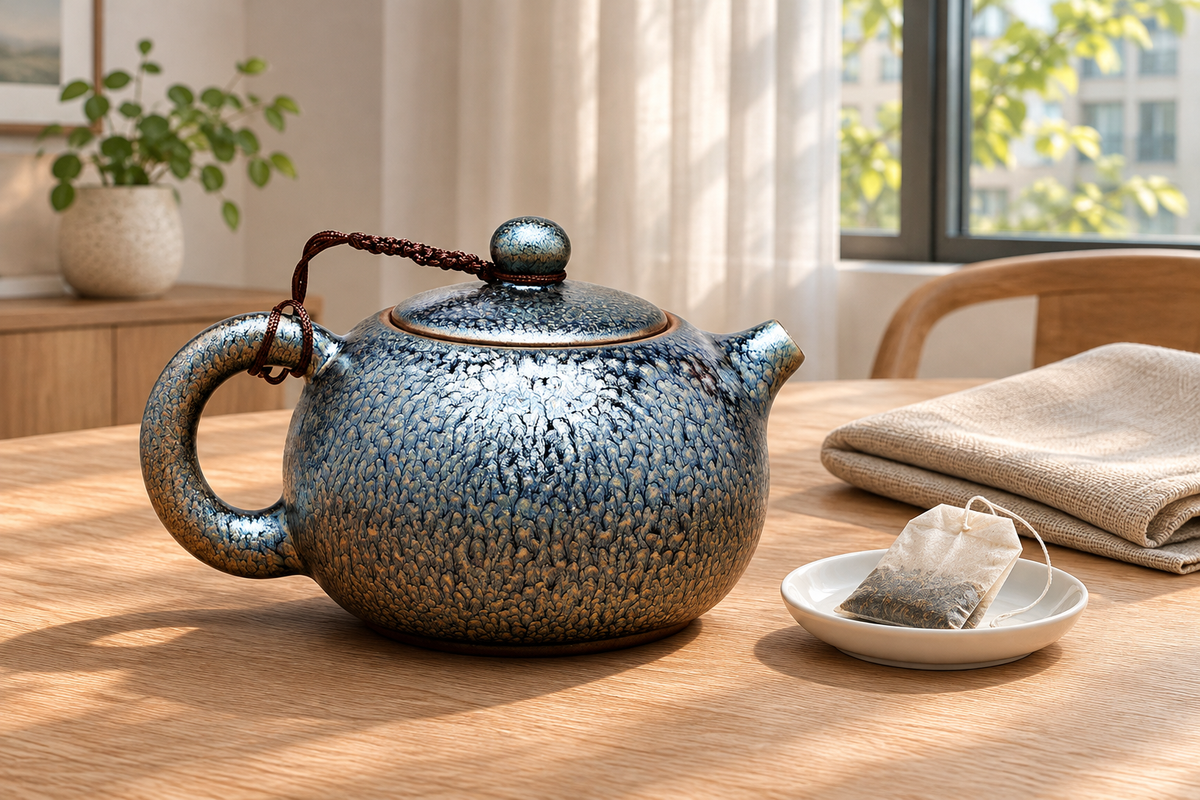
The Petal Flow Tenmoku Ceramic Teapot is listed at a nominal capacity of 300 ml. Its product photograph shows a rounded body, loop handle, short spout, and a removable lid. It is a brewing-pot option for a modest quantity of tea rather than several full-size mugs.

For a bag labelled for 250 ml, a measured 250 ml brew is a possible starting plan only if that quantity fits comfortably with the wet bag and the lid seated. This is a volume example, not a tested fit claim for every brand of sachet. Larger pot-size bags may need a wider opening or more space than this small pot provides.
Choose it if you prefer one modest serving or several small pours and like its blue-silver patterned glaze. Choose a larger brewing pot if your usual routine is two large mugs at once. You should not have to refill and rebrew several times merely to compensate for a pot that is too small for your household.
No extra infuser, matching cup, or packaging item is assumed in this example. Check the current product listing and ask about any accessory you specifically need. For a broader comparison of volume, cleaning access, and pouring comfort, see choosing the right teapot.
Why does tea from the pot taste weak or bitter?
Weak tea: check the water amount first
A common mismatch is moving one familiar bag from a mug into a much larger teapot while keeping the same brewing time. Measure how much water the pot actually holds at your normal fill line. If you have doubled the water without changing the tea quantity, correct that proportion before extending the steep indefinitely.
Also check that the bag is properly wetted rather than perched in a basket above the water. A timer cannot compensate for leaves that have barely touched the liquid. Once the ratio and contact are right, make small taste adjustments within the tea maker's suggested range.
Bitter or drying tea: check time and temperature
If the tea is unpleasantly strong, leaving the bag in while you drink slowly may be the reason the second pour tastes different from the first. Remove it at the end of the intended steep. Check the package's temperature too, particularly when changing from one tea type to another.
For tea that is already too concentrated, a little additional hot water in the cup may make it more drinkable. It will not necessarily remove an unpleasant over-steeped flavour. For the next batch, change the cause rather than masking it with more milk or sugar.
Uneven servings: finish the brew before sharing
If you pour one cup halfway through brewing and another several minutes later, the two servings are unlikely to match. Complete the timed steep, remove the bags, then divide the tea. Add milk, lemon, or sweetener in individual cups when people's preferences differ; this also keeps the brewing pot simpler to clean.
After brewing: remove, rinse, and dry
Take out used bags rather than leaving them in the pot until the next session. Once the vessel has cooled enough to handle safely, clean it according to its care directions. Pay attention to the underside of the lid, the opening, and the spout, where tea residue may remain.
For an unfamiliar ceramic pot, do not assume dishwasher or microwave compatibility from its appearance. Avoid abrasive cleaning tools and sudden temperature changes. Let the pot and lid dry separately before putting them away. These checks are especially useful if you alternate plain tea with strongly scented blends.
Quick answers about tea bags in teapots
Can I leave the bags in while I drink?
For a repeatable result, remove them when the recommended steep is finished. Leaving them in keeps the leaves in contact with the water and can change later pours. A pot is a convenient serving vessel after brewing; it does not need to keep extracting tea throughout the whole break.
Can I brew just one bag in a large teapot?
Yes, if you use the water quantity intended for that bag and it can sit in the water. A large pot does not need to be full. Check that a shallow infuser is not holding the bag above the reduced fill level, and expect a partly filled vessel to behave differently from a full one.
Can I use the same bag for a second pot?
A second infusion may taste different or much weaker. Whether it is worthwhile depends on the tea and your preference; do not count on one ordinary bag producing two identical pots. For guests or a repeatable daily serving, start with fresh bags at the stated ratio.
Should I buy a teapot if I only drink bagged tea?
Only if the serving routine suits you. A mug remains the simplest choice for one quick drink. A small teapot earns its place when you enjoy several pours, want to separate brewing from drinking, or share a measured batch. Prioritise usable capacity and easy bag removal over accessories you will not use.
The simplest reliable routine is also the most adaptable: measure the water, match the tea bag's stated serving size, use its recommended temperature and time, and remove it before pouring. A suitable teapot then becomes a comfortable way to serve the tea you already enjoy.
Share:
Tea Cups vs Espresso Cups: When Can You Use the Same Cup?