

A tea cup does not always need a saucer. A well-fitting saucer is useful for catching small drips and giving a spoon somewhere to rest. A suitable coaster may be enough when you simply want a place to set down a handleless cup. The right choice depends on the cup’s base, the surface underneath it, and how you actually serve tea—not just whether two pieces share a pattern.
If you are buying a tea cup and saucer together, fit should be part of the purchase decision. If you already own a favorite cup, there is no need to replace it just because it arrived without a matching plate. Start with the job you want the extra piece to do, then check whether it makes the cup easier to use.
What is a tea cup saucer for?
A saucer is a small dish placed beneath a cup. Many have a recessed center, or well, intended to accommodate the cup’s foot. The surrounding rim can catch a few drops that run down the outside after a sip or a slightly untidy pour. On a roomy saucer, there may also be space for a teaspoon after stirring.
Those benefits have limits. A shallow saucer cannot contain a large spill, and a cup balanced on the edge of an undersized well can be less stable than it would be on a flat surface. Ceramic also transfers heat; the presence of a saucer alone is not proof that a delicate tabletop is protected. Follow the surface manufacturer’s care requirements and choose an appropriate barrier when needed.
Think of a saucer as a functional part of a serving arrangement, rather than a compulsory companion to every tea cup. It earns its place when it solves a real problem: stray drips, a wet spoon, or the need for a clear individual setting when serving guests.
Saucer vs coaster: which one suits your routine?
A coaster primarily provides a landing place between a drink and the table. Depending on its material, it may absorb moisture or provide some heat resistance, but those properties are not universal. A saucer is a dish: its shape can contain small amounts of liquid and may locate a compatible cup within a central well. Neither option is automatically safer or more useful in every setting.
| Your main need | Option to consider | What to check | What it will not solve |
|---|---|---|---|
| Catch small drips beside the cup | A compatible saucer | The cup rests flat in the well, with usable space around it. | Large spills or an overfilled cup |
| Set a handleless cup down between small pours | A firm, level coaster suitable for hot drinks | The entire foot is supported and the material does not buckle. | A cup that is too hot to hold |
| Rest a teaspoon after stirring | A roomy saucer or separate spoon rest | The spoon does not interfere with lifting or replacing the cup. | Crowding caused by a large cup on a tiny saucer |
| Move several cups to a table | A stable serving tray | A clear route, secure grip, and uncrowded placement | The need to keep hot drinks away from edges and electronics |
| Protect a moisture-sensitive finish | A surface-compatible protective layer | The underside stays dry and the material suits that finish. | Moisture trapped beneath a wet saucer or coaster |
A soft, folded cloth is not a direct substitute for a firm coaster. Seams and wrinkles can tilt a small-footed cup. Likewise, a decorative plate may look right but have a curved center that prevents the cup from sitting securely. Check the contact surfaces, not just the overall appearance.
Can you use a handleless tea cup without a saucer?
Yes. A handleless cup can be used without a saucer when it has a stable resting place and is comfortable to handle at the temperature of the tea. The absence of a handle does not create a universal requirement for a matching dish. Nor does a small cup automatically remain cool enough to grip.
For repeated small pours, place the cup where you can reach it without leaning over the brewing vessel. Leave room to lift it without brushing against neighboring pieces. If the outside feels too hot, leave the cup on its stable support and wait. Adding a saucer does not make a hot rim or body comfortable to touch, and carrying a full cup on a slippery dish is not a substitute for a secure grip.
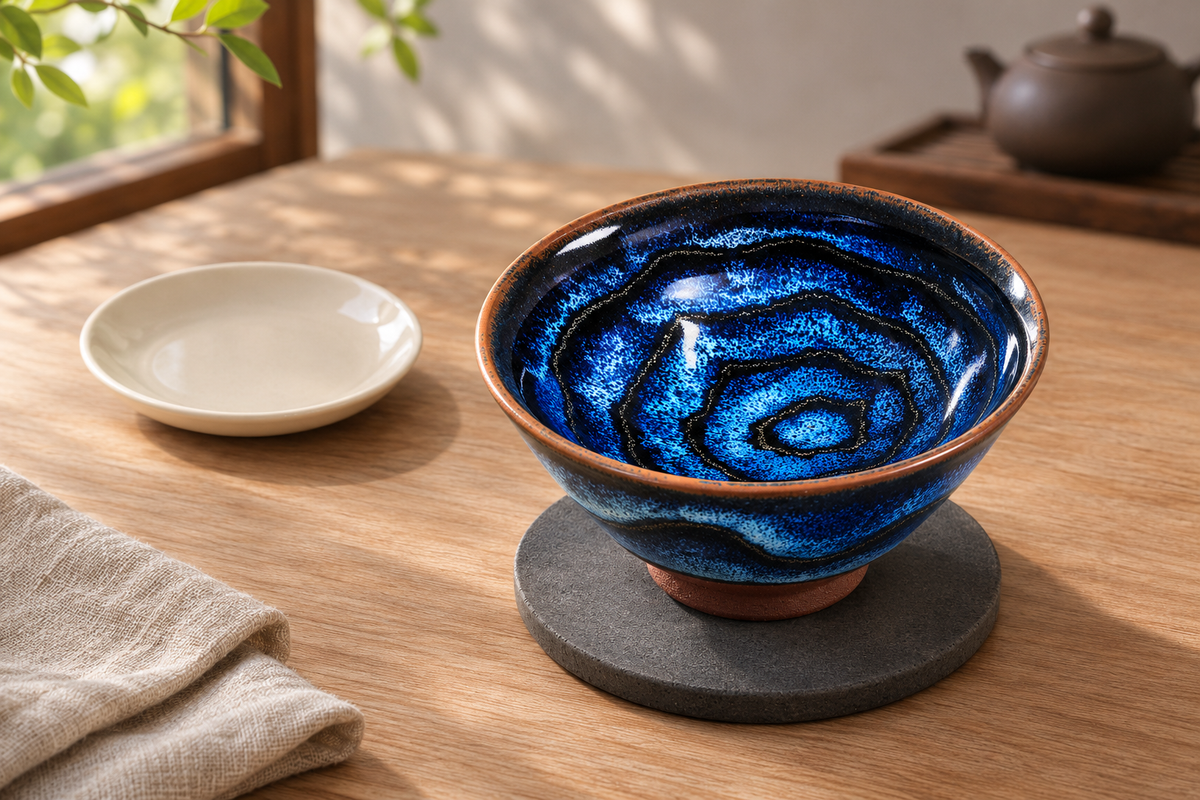
The Coiled Dragon Tenmoku Ceramic Tea Cup is a useful example of this kind of choice. Its product photos show a handleless, flared bowl with blue-and-black glaze bands and a reddish-brown foot. The listing gives a capacity of 130 ml and a diameter of 9.5 cm. Those figures describe the cup; they do not establish which saucer will fit underneath it.

A quiet, neutral support can keep attention on that glaze, but color coordination is a separate decision from fit. No saucer or coaster compatibility has been established here. The banner is an illustrative scene; its surrounding accessories do not establish what is supplied with the cup. Check the current product listing and confirm any required accessories before ordering.
How to match a saucer to a cup you already own
The most useful measurement is the part of the cup that touches the saucer. This may be a narrow foot ring rather than the full width of the bowl. A wide opening can sit above a much smaller base, so choosing a saucer solely from the cup’s rim diameter can lead to the wrong purchase.
- Measure the outer width of the foot. Use the actual cup where possible. If shopping online, ask the seller for the base measurement when it is missing.
- Check the saucer’s flat central area. Its usable well needs to accommodate the foot without leaving it perched on the raised edge.
- Check the surrounding clearance. A flared bowl should not collide with the saucer rim, and your fingers need room to lift the cup comfortably.
- Test the empty pair on a level surface. Look for rocking, uneven contact, or an awkward fit. Reject a combination that only seems stable when carefully balanced.
- Try your normal placement motion. You should be able to put the cup down naturally, without precisely aiming at a tiny recess each time.
For example, the Coiled Dragon listing’s 9.5 cm diameter should not be treated as its foot diameter. The product side photo visibly distinguishes the broad bowl from the smaller foot, but it does not provide a measured base size. Without that measurement, recommending a specific replacement saucer size would be guesswork.

Three everyday situations—and three different choices
Tea at a desk
At a desk, a compact, stable landing place may matter more than a formal setting. Choose a coaster that supports the whole foot and suits hot drinks and the desk finish. Keep the cup away from a keyboard, cables, and the desk edge. A saucer is worth adding if drips are common or you stir the tea, but it should not make the available space so crowded that your hand catches the rim.
Tea with a guest
For a guest, a saucer can provide an obvious place to return the cup and rest a spoon. Set it out so the cup is easy to reach and there is room for any separate snack plate. If you serve unsweetened tea in handleless cups, you may not need spoons at all. Two stable coasters can make a clear, uncomplicated arrangement without pretending to be a matched porcelain service.
Several small pours at a tea table
When you refill cups frequently, choose a support that stays level through repeated lifting and setting down. A narrow saucer well that catches the foot can become irritating even if the pieces look attractive together. Keep any pouring area separate from the dry place where you rest the drinking cup. For the broader layout, see our article on tea accessories for a small tea table; the cup-and-support fit still needs its own check.
What to check before buying a tea cup and saucer set
Start with the included-pieces list. A styled photograph may show a cup, saucer, spoon, tray, and cloth even when the offer contains only one item. Confirm the number of cups and saucers separately, along with the selected option. Do not assume that a listing called a “tea set” contains the particular pieces you need.
- Confirm whether the saucer is included, optional, or only a photographic prop.
- Compare capacity with the amount you normally drink, leaving comfortable space below the rim.
- Look for a base measurement and saucer-well measurement, or confirmation that the pieces are designed to fit together.
- Check whether the cup is sold singly or as part of a multi-piece selection.
- Check care information for each piece rather than assuming the cup and saucer tolerate identical treatment.
- Consider storage space for the complete arrangement, not just the cup.
For a handleless cup bought separately, begin with the cup you want to drink from. The Jianzhan and Tenmoku collection offers a starting point for comparing glaze and shape. Then decide whether your routine actually calls for a saucer, a coaster, or an appropriate existing tray. Avoid adding accessories solely to make a photograph look complete.
Common questions about tea cups and saucers
Do the cup and saucer have to match?
They do not have to share the same color or decoration for casual use. A plain saucer can sit comfortably beside a patterned cup visually. Physical compatibility matters more: the cup should rest level, lift cleanly, and return to its place without wobbling. A matching color does not compensate for an incompatible well.
Can a small plate replace a saucer?
Sometimes, provided the cup sits flat and securely on it. Check for a curved center, a slippery surface, or a raised pattern under the foot. A plate without a locating well will not position the cup in the same way as a compatible saucer. Test it empty first and choose another option if it rocks.
Does a saucer stop a tea cup from getting hot?
No. It supports the cup and may catch drips, but it does not cool the cup’s gripping surface on demand. Let hot tea and the vessel cool to a comfortable temperature before handling or drinking. Do not infer heat protection from the appearance of a ceramic dish or decorative coaster.
Should I buy the cup or saucer first?
If you want a coordinated set with no separate fit decisions, buy pieces explicitly sold as a compatible pair. If a particular handleless cup is the priority, choose that cup first and check its foot before selecting a support. For the Coiled Dragon cup, the missing base measurement is a reason to confirm fit—not a reason to guess from its broad opening.
Choose the support that earns its place
A saucer is worthwhile when its dish shape, spoon space, and compatible well improve the way you serve tea. A firm, suitable coaster may be the simpler choice when all you need is a stable resting place for a handleless cup. Either way, check the base, keep the underside dry, and leave enough room to pick up the cup comfortably. The best pairing is one you can use naturally, not one that only looks convincing in a styled photograph.
Share:
Colorful Tea Cups: Choosing Color, Pattern and Shape
Glazed vs Unglazed Teaware: Choosing for Different Teas