

A small tea table works best when every object earns its place. You need somewhere to brew, something to drink from, a stable surface for hot vessels, and a way to deal with drips. A serving pitcher, strainer, scoop, and larger tray can make particular routines easier, but buying them all at once often creates the very problem a compact setup should solve: too many things between your hand and your cup.
The right tea accessories depend on the tea you make, the number of people you serve, and how much space remains after the equipment is set down. Start with the routine you already have. Then add the piece that removes a specific inconvenience, such as uneven portions, leaf fragments in the cup, or a wet tabletop. This approach keeps both the table and the shopping list manageable.
The smallest useful tea setup
For loose-leaf tea, a compact arrangement can begin with one brewing vessel, one drinking cup per person, and a heat-appropriate resting surface. Keep hot water on a stable surface within comfortable reach. A clean cloth handles small drips, while a suitable bowl can collect discarded water when the sink is inconvenient. You do not need a large draining tea tray simply to begin.
Choose one brewing method first. A gaiwan is a lidded bowl used to steep leaves and pour the infusion through a small gap between lid and rim. A teapot offers a different grip and pouring arrangement. An infuser basket in a suitable mug can be enough for a single longer steep. Buying all three methods before using any of them makes a small collection harder to organize.
- For one person: a brewer, one cup, a small resting surface, and a cloth are a practical starting point.
- For two people: add a second cup and consider a serving pitcher to divide one infusion evenly.
- For a shared dining table: choose a setup that can be cleared easily and stored dry between uses.
- For a desk: keep brewing and pouring away from electronics, cables, and the table edge.
Which tea accessories are worth the space?
Use the table below as a buying checklist. The household alternatives are options only when they are suitable for food contact, hot liquids, and the intended use. A decorative tray or ordinary drinking glass is not automatically suitable for holding hot vessels or freshly brewed tea.
| Item | What it does | When to add it | What may already work |
|---|---|---|---|
| Serving pitcher | Holds a decanted infusion before it is shared. | When serving several cups or when the brewer holds more than one cup can receive. | A clean, heat-suitable small jug with a controlled pouring lip. |
| Tea strainer | Catches loose leaf fragments during pouring. | When fragments regularly reach the cup and bother you. | An existing food-grade fine strainer that rests securely over the receiving vessel. |
| Small tray or resting surface | Organizes vessels and protects the table when suitable for heat and moisture. | When drips or scattered pieces make the setup inconvenient. | A stable heat-resistant mat with a suitable dish for drips. |
| Tea cloth | Wipes small drips and helps keep the working area dry. | From the first session. | A clean, absorbent cloth reserved for the tea area. |
| Scoop or small scale | Transfers leaves or measures repeatable amounts. | When dosing is messy or the strength varies more than you want. | A dry spoon; an existing kitchen scale for weight. |
| Waste-water bowl | Collects water discarded during the session. | When repeated trips to the sink interrupt pouring. | A stable bowl suitable for hot water, kept away from the edge. |
Measure the usable table, not just the tray
Before buying a tray, arrange the pieces you already own on the table. Leave space to lift the brewer without knocking the cup, set down a lid, and bring the pitcher close to the receiving vessel. A tray that fits the tabletop exactly may still be too large if it leaves no safe place for the kettle or your hands.
Paper circles are a useful way to test a new purchase. Cut or mark circles matching the listed diameters, then add the saucer and pitcher footprints separately. Include protruding handles and spouts. The circles should not touch. You need room around each object for a comfortable grip, not just enough area to pack the equipment tightly together.
Also measure the shelf where everything will live. A compact tabletop arrangement loses its advantage if the pitcher cannot fit upright in the cupboard or the tray must be stored wet behind other objects. Storage height, drying space, and access to the sink are part of the purchase decision.
A gaiwan that gives the table a clear focal point
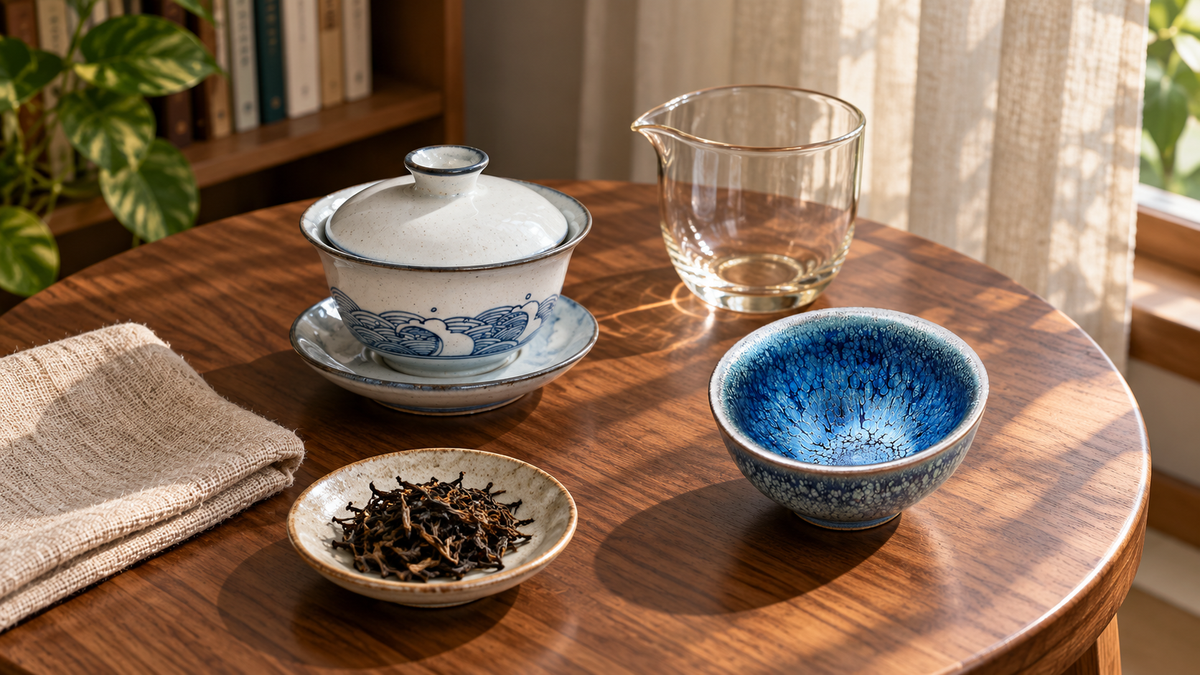
The Blue and White Wave Pattern Gaiwan offers a blue-and-white brewing piece for a restrained tea arrangement. Its listed capacity is 150 ml and its listed diameter is 9.5 cm. The product photographs show a lidded bowl and matching saucer, with blue wave decoration around the pale ceramic body.
Those measurements help with planning, but they do not establish the amount of finished tea in every pour. Leaves occupy space, absorb water, and affect how much liquid you can pour out. Leave enough headroom to handle the vessel comfortably. Check the complete saucer footprint when selecting a tray rather than assuming the bowl diameter describes the whole assembly.

For a first gaiwan, grip comfort matters more than coordinating every accessory. Practise the movement with cool water before handling hot tea. If the lid or rim feels awkward in your hand, a familiar teapot may be a better everyday brewer. A pleasing pattern cannot compensate for a vessel you find difficult to pour.
Match receiving capacity before matching colors
A common shopping mistake is pairing a brewer and cup because their colors look good together without checking where the full infusion will go. The receiving vessel needs enough usable space for the liquid you actually decant. A cup filled to the brim is difficult to carry and leaves little margin for an uneven pour.
The Azure Ocean Crackle Glaze Tea Cup has a listed capacity of 120 ml and diameter of 9 cm. Its blue interior provides a different visual texture beside a pale wave-pattern gaiwan. It is a drinking cup, not a substitute for a brewing vessel or a large mug.
A 150 ml listed-capacity gaiwan and a 120 ml listed-capacity cup should not be treated as a guaranteed one-pour match. If you brew an amount greater than the cup can comfortably receive, decant into a suitably sized serving pitcher first. Alternatively, use a smaller measured batch or share the infusion between cups. Do not leave excess tea steeping with the leaves merely because the first cup is full.

These two products are separate purchases, not a bundled set. Any pitcher, cloth, tray, or other styling prop shown alongside them should not be assumed to be included. Confirm the selected product and its contents on the product page before ordering.
When a serving pitcher earns its place
A serving pitcher, often called a fairness pitcher or gong dao bei, receives the tea after brewing. It lets you finish decanting before you divide the infusion among people. This is particularly useful when you have different-sized cups or when conversation makes it difficult to pour into several cups in quick succession.
Select capacity around your actual poured volume rather than matching the printed capacity of the brewer exactly. Allow comfortable headroom. Check that the pouring lip is easy to aim, the grip is secure, and the opening is wide enough to clean without struggling. A beautiful narrow-necked vessel may be inconvenient if you cannot reach the inside.
For a solo session with a small batch that fits comfortably in one cup, a pitcher can be optional. For the 150 ml gaiwan and 120 ml cup combination above, it becomes useful whenever the brewed amount exceeds the cup's comfortable serving level. The need comes from your pour, not from a rule that every tea table must contain the same accessories.
When a strainer or draining tray can wait
A strainer is useful if the tea contains fragments that regularly escape into the cup. It is not automatically necessary for every loose-leaf tea. Try the brewer first, then decide whether you mind the amount of leaf material that reaches your drink. If you add a strainer, check that it rests securely over the pitcher and does not require you to balance several hot pieces at once.
A draining tray suits a routine that produces substantial rinse water or frequent spills. A mostly dry arrangement may work better with a small dish, cloth, and waste-water bowl. The smaller option is often easier to empty and dry. Before buying a draining tray, check how its reservoir is removed, whether it has a hose, and how you will clean every part.
Tea pets, matching tool holders, and decorative display stands can wait until the working layout feels comfortable. They may be enjoyable additions, but they should not occupy the space needed for a secure pour. Buy them for the pleasure they bring, not because they appear in a photograph of a complete tea table.
Arrange the table around your pouring hand
- Place the brewer within easy reach. You should not need to stretch over a cup to pick it up.
- Keep the receiving vessel nearby. A short, clear pouring path is easier to control than reaching across several accessories.
- Reserve a place for the lid and strainer. Use stable resting spots so wet pieces do not end up beside the table edge.
- Separate dry leaves from splashes. Keep the tea container closed and use a dry spoon when measuring.
- Keep waste water distinct from drinking tea. Place its bowl out of the main serving area, but close enough to use without reaching over someone.
Reverse the arrangement if that suits your dominant hand. Test the entire sequence with cool water before settling on a layout: fill, lift, pour, replace, and wipe. Move any object that repeatedly blocks your hand. A compact tea station should be convenient while you are using it, not only when photographed from above.
Buy in stages and avoid unnecessary duplicates
Start by listing what you already have. A suitable cup, kitchen scale, dry spoon, and clean cloth may already cover several tasks. Spend first on the brewing or drinking piece that is genuinely missing. Use the arrangement for several sessions before buying the next accessory.
Write down a specific reason for each addition. “I need to empty the brewer before serving two people” is a sound reason to buy a pitcher. “This set has more pieces” says little about whether those pieces will be useful. Sets can be convenient, but compare the included items with your actual routine and count the cups, not just the total number of components.
For a gift, ask whether the recipient already owns a brewer. A distinctive cup may be more useful than a second full setup. If they are starting from scratch, check that any set contains the pieces needed for brewing and serving; a gift box does not by itself mean that a pitcher, tray, or accessories are included.
Make cleanup part of the setup
After the session, remove used leaves, empty collected water, and wash the pieces according to their individual care details. A soft sponge and thorough rinse are a practical starting point for glazed teaware. Avoid sudden temperature changes and abrasive tools. The two featured product records specify that microwave use and direct stove heat are not suitable.
Dry lids and bowls separately before putting them away. Empty tray reservoirs and let cloths dry fully instead of folding them into a damp bundle. If your arrangement takes longer to clean than you want to spend, reduce the number of accessories left on the table. The best compact setup is one you are happy to use again tomorrow.
Your next purchase should solve one problem
If you need a brewing centerpiece, compare the 150 ml Blue and White Wave Pattern Gaiwan with the space and grip you have available. If you already have a brewer and want a blue drinking cup, consider the 120 ml Azure Ocean Crackle Glaze Tea Cup. Check working capacity before combining them, and add a pitcher when your pouring volume calls for one.
Keep the table open enough to use comfortably. One appropriate brewer, a cup you enjoy, and a few accessories chosen for real tasks can make a small tea corner more practical than a crowded collection of matching objects.
Share:
Tea Ceremony at Home: Choosing and Using Your Teaware
Handmade Ceramic Tea Cups: Choosing Size, Rim, and Grip