

A handmade ceramic tea cup can look beautiful on a shelf and still feel wrong during an ordinary tea break. The opening may be wider than your usual grip, the rim may feel heavier than expected, or the listed capacity may be smaller than the amount you normally pour. Glaze color is easy to compare online. Comfort takes a more deliberate look at size, shape, and the way you actually drink.
Start with three questions: how much tea do you want in one serving, where will your fingers touch the cup, and what kind of edge do you prefer against your lips? These questions narrow the choice without assuming that one cup shape suits everyone. A small handleless bowl can be a satisfying choice for repeated pours, while a familiar handled cup may suit someone who wants a larger drink with less frequent refilling.
Begin with the cup you already reach for
Before shopping, take a cup you use comfortably and measure its widest diameter and overall height. Then measure the amount of water you normally put into it, leaving your usual space below the rim. Record that serving volume separately from any capacity printed on the packaging. This gives you a personal reference that is more useful than deciding that a cup looks small or large in a photograph.
Notice your grip as well. Do you hold the cup near the top, cradle the lower body, use a handle, or support it with both hands? A wide bowl might suit one of those movements and interrupt another. You do not need a perfect set of measurements; you need enough information to avoid buying a shape that conflicts with a habit you enjoy.
- Measure the outside width where your fingers usually rest.
- Compare the normal serving amount, not only the maximum capacity.
- Check the cupboard space and the size of your usual coaster.
- Write down one thing you like and one thing you would change about your current cup.
Capacity and width answer different questions
Capacity describes a volume. Diameter describes a width. Neither tells the whole story of how a cup will feel. Two cups with the same listed capacity can have different openings, wall angles, bases, and overall heights. One can spread its volume across a shallow bowl; another can hold it in a narrower, deeper shape.
A listing may not state whether capacity was measured to the brim or at a practical serving level. Do not assume that the full advertised amount is comfortable to carry. Leave room for movement and for the tea to approach your lips without an abrupt spill. If you need a precise serving quantity, ask how the capacity was measured rather than estimating it from the outside dimensions.
For a small-batch tea session, match the cup to the amount you serve per person. For example, dividing a measured 150 ml of finished tea among three people gives 50 ml each. That arithmetic describes the poured tea, not the nominal volume of the brewer, because leaves and brewing technique affect the amount that reaches the serving pitcher. A cup with extra room above that portion can be more convenient than one filled right to its edge.
| Feature | What it helps you judge | What it cannot prove | Useful check before buying |
|---|---|---|---|
| Listed capacity | Approximate size of the serving vessel | Your comfortable fill level | Compare with a measured portion at home |
| Outside diameter | Hand span and tabletop footprint | Inside opening or wall thickness | Compare the same measurement on your usual cup |
| Side profile | Wall angle, base, and overall proportions | Exact weight or balance | Request a side photograph if only overhead views exist |
| Rim close-up | Visible edge shape and glaze finish | How the edge feels against your lips | Compare rounded, outward, and straighter profiles |
| Selected option | The particular shape being ordered | That every option shares the same dimensions | Match the option name, photo, and specifications |
The rim is the part you meet with every sip
Look at the edge from the side as well as from above. A rounded rim presents a different contact surface from a visibly fine edge. An outward-opening profile also changes the angle at which the tea reaches your mouth. These are preference questions, not a ranking in which thinner or wider automatically means better.
If your favorite cup has a substantial rounded edge, an extremely fine-looking rim may feel unfamiliar. If you prefer a lighter contact point, a thick-looking edge deserves closer inspection. Photographs can help you shortlist shapes, but lighting and camera angle can exaggerate thickness. Without a stated measurement or a physical comparison, describe a rim as visually rounded or fine rather than assigning an exact thickness.
Once the cup arrives, inspect the rim in good light before use. It should not have a sharp chip or rough damage where your lips touch. Handmade variation is different from damage that interferes with drinking. If something looks wrong, photograph it and contact the seller before using the cup rather than trying to smooth the edge yourself.
Grip comfort depends on the whole profile
A handleless tea cup asks your fingers to support the body directly. The width at that contact point matters more than the widest measurement alone. A bowl that flares toward the top can be narrower lower down, while a straighter-sided cup offers a different contact area. Think about where your fingers naturally land instead of copying a formal-looking grip from a photograph.
The base matters too. It affects how the cup meets the table and how easily you can put it down without watching every movement. A small foot can look elegant, but a photograph does not establish stability or balance when the cup is filled. Check the base on a level surface after delivery, and try the lifting motion with cool water before serving hot tea.
Do not treat exterior texture as a guarantee of a secure grip. Glazed surfaces, moisture, hand size, and the cup's weight all affect handling. Keep your hands and the outside of the cup dry. If you need to squeeze tightly or stretch awkwardly to lift it, a different profile may be a better everyday choice even if the glaze is your favorite.
A compact option: Golden Lotus Glaze Tea Cup
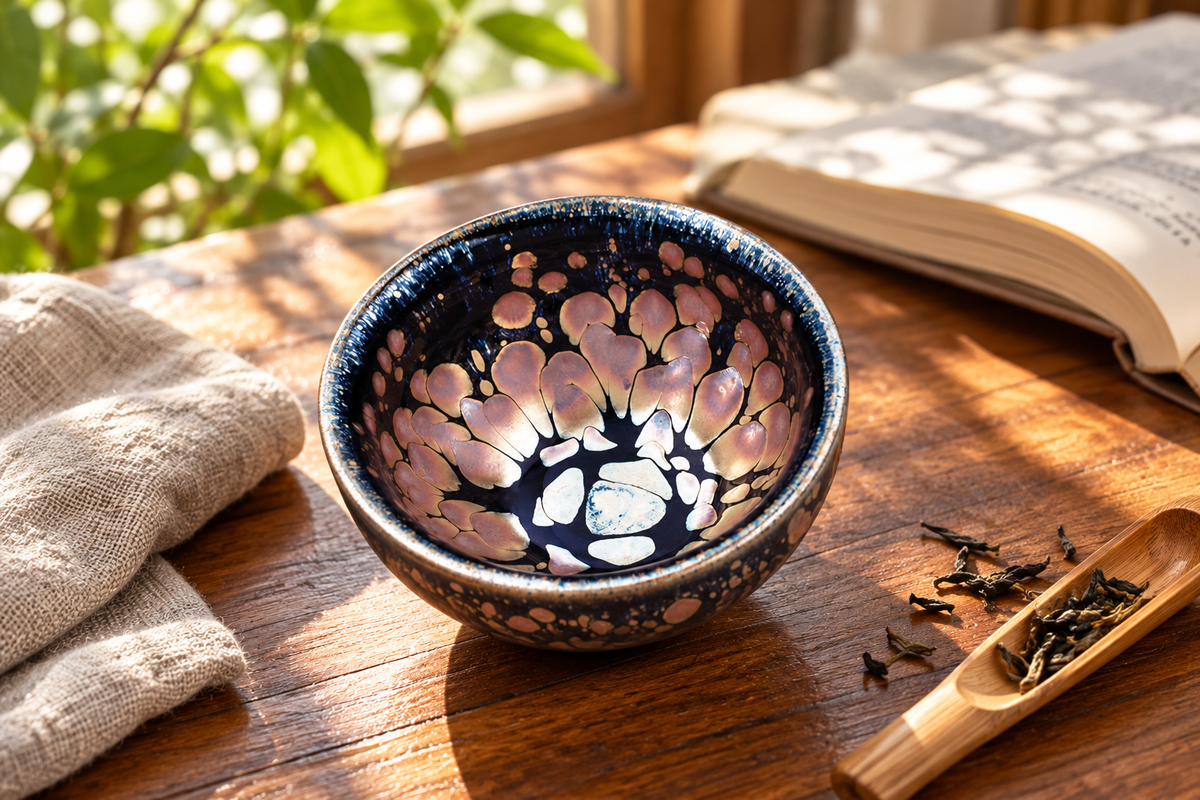
The Golden Lotus Glaze Tea Cup has a listed capacity of 100 ml and diameter of 7.6 cm. Its product photographs show a rounded, handleless bowl with a dark interior and golden-purple petal-like markings. Those details make it a concrete option to compare with your own small drinking cup, rather than a large mug replacement.

Use those figures for an initial size comparison, not as a promise that 100 ml is the ideal serving amount. If your normal tea break involves a much larger drink, this cup means smaller portions and more refills. That can suit a shared session with repeated pours, but it may not match a desk routine built around one large cup.
The photograph also shows why an interior view and a side view serve different purposes. The overhead angle makes the glaze pattern easy to see, while a side photograph is more helpful for judging where you might place your fingers. Neither establishes exact weight, rim thickness, or a guaranteed improvement in flavor. Choose it because its size and appearance fit your routine.
Different shapes within one product listing
The Peacock Blue Lotus Tea Cup currently offers options named Arhat, Beauty, Hat, and Zen. This is a useful reminder that a product name alone may not identify the cup shape you are ordering. Compare the photograph associated with the selected option before adding it to the cart.

The product page includes shared measurements, but shared text should not be treated as proof that every differently shaped option has identical dimensions. If a particular width or serving volume is essential, confirm it for the chosen option. The comparison here is about checking shape and selection, not assigning one measurement to all four designs.
Multiple cups in a photograph can show different angles or styling arrangements. They do not by themselves establish the quantity supplied. Likewise, a teapot, tray, or other prop beside a cup should not be assumed to be included. Check the item description and selected option separately from the scene in the photograph.
Read product photographs in a practical order
- Start with the side view. Look at the opening, wall angle, and base before concentrating on the decorative pattern.
- Check the overhead view. Compare the opening shape and visible rim, remembering that perspective affects apparent proportions.
- Look for scale. A ruler or stated dimensions is more dependable than nearby props of unknown size.
- Match the selected option. Confirm that the image and option name refer to the same version.
- Note what remains unknown. Ask about weight or option-specific dimensions if those would decide the purchase.
A hand in a photograph can provide context, but hands differ in size and a camera can distort the apparent relationship. Treat it as a rough visual reference, not a measurement. An AI-styled lifestyle header also illustrates a setting rather than documenting dimensions or package contents; use the actual product photographs and specifications for those decisions.
Try the cup before committing to a daily routine
After inspecting the cup, wash it according to its care details and test a modest amount of cool water. Lift it, bring it toward your mouth, and set it down on the surface you normally use. Notice whether your fingers have to reposition, whether the rim angle feels natural, and whether the base lands comfortably inside your coaster.
Then consider your ordinary serving routine. Can the cup receive your intended portion with room below the rim? Does it require more refilling than you want? Does the opening make cleaning straightforward? These small practical checks often say more about long-term use than comparing decorative names.
Hot tea changes the handling experience, so do not assume that a comfortable cool-water grip will remain comfortable immediately after pouring. Let the vessel and drink reach a comfortable temperature. A handleless cup is not insulated simply because it is ceramic, and a smaller size does not guarantee that its exterior stays cool.
Choose a gift around the recipient's habits
For someone who already serves small rounds from a teapot or gaiwan, a distinctive small cup can complement existing equipment. For someone who usually drinks a large mug while working, confirm that they actually want a smaller vessel before selecting one. The recipient's routine is a better starting point than the number of pieces or the visual impact of the box.
If you cannot ask directly, compare a cup they already use and keep the decision simple. Choose a familiar size category, avoid assuming that every accessory in the photos is included, and check the current gift packaging details on the selected product page. A single cup and a multi-cup set meet different needs, even when both arrive attractively packaged.
Make the final choice in three steps
First, choose a serving size that matches the way you pour. Second, compare the opening and body profile with a cup you already hold comfortably. Third, choose the glaze you would enjoy seeing every day. This order keeps visual appeal in the decision without allowing it to hide an unsuitable size.
The 100 ml Golden Lotus Glaze Tea Cup is a specific starting point for a compact, rounded drinking cup. The Peacock Blue Lotus options provide a reason to compare individual silhouettes more closely. Neither replaces an honest check of your own grip and serving habits. The most useful cup is the one whose proportions make everyday tea feel comfortable, not the one that wins on appearance alone.
Share:
Tea Accessories for a Small Tea Table: What You Actually Need