

A mug is often the practical choice when you want to brew one generous drink and carry it to your desk. A small tea cup makes more sense when you brew separately, pour a little at a time, and enjoy several servings. Neither vessel is automatically better: the useful distinction is how it fits your routine.
That matters when buying a handleless ceramic cup online. An attractive bowl-shaped cup may be exactly right for pouring tea from a small pot, but frustrating if you expect it to replace a large breakfast mug. Start with the way you prepare and drink tea, then choose the vessel that makes those steps comfortable.
Tea cup vs mug: the practical difference
In everyday language, a mug is a type of cup, not a completely separate category. It usually suggests a roomy vessel with a handle. A tea cup can mean a Western cup with a saucer, a small handleless Chinese cup, or other drinking vessels made for tea. There is no single capacity or handle rule that covers every product.
For this comparison, “small tea cup” means a vessel used mainly to receive brewed tea in smaller pours. “Mug” means a larger handled vessel that can hold a longer drink, sometimes with a tea bag or removable infuser inside. These are useful descriptions of a setup, not rigid definitions of what you are allowed to drink from.
The main purchase question is therefore not whether your tea deserves a special cup. It is whether you prefer keeping most of your drink in your hand, or keeping it in a separate brewing or serving vessel and refilling a smaller cup.
Choose by the moment you actually drink tea
| Your routine | Often the easier choice | Why it fits | What to check |
|---|---|---|---|
| Tea bag at a busy desk | Handled mug | One vessel for steeping and drinking; fewer refills | A place for the used bag and a stable base |
| A short, seated tea break | Small tea cup with a separate brewer | A modest pour suits a pause without filling a large mug | Comfortable grip and enough room below the rim |
| Sharing one pot between two people | Two tea cups | Divide the infusion into manageable servings | Usable cup volume relative to the pot's tea output |
| Repeated small infusions | Small tea cup | Finish one serving before pouring the next | A convenient place for the pot, cup, and drips |
| Milk tea with room to stir | A suitably roomy mug or larger tea cup | Space for additions without filling to the edge | Total drink volume, not just the brewed tea |
When a mug is the simpler purchase
If your usual routine is boiling water, adding a tea bag, and returning to work, a mug avoids adding another vessel to wash. A removable infuser can serve a similar purpose for loose leaves, provided it fits the mug and gives the leaves room. Remove the bag or infuser when the tea has steeped for the time you prefer.
A handle may also suit someone who dislikes touching the body of a warm cup. Check the space inside the handle and how the mug balances when filled; a large-looking handle is not necessarily comfortable for every hand. Product weight and dimensions are more useful than assuming that any handled design will feel light.
For a drink with milk, leave room for both the milk and stirring. Choose based on your actual serving rather than the largest advertised capacity. An open mug is still not a spillproof travel container, and a large drink can be awkward to carry around a crowded desk. If transport is the priority, a purpose-made travel vessel is a separate purchase decision.
When a small tea cup earns its place
A small cup fits a routine in which brewing and drinking happen separately. You can brew in your existing teapot, remove or strain the leaves as appropriate, and pour a comfortable amount into the cup. The cup does not need to hold the entire pot. The remaining tea stays in a suitable serving vessel until the next pour.
This arrangement is useful for a seated break or for sharing tea. Each person receives a smaller serving, and you can refill as needed instead of handing everyone a large drink at the start. If you make successive infusions, finish or empty the previous serving before adding the next when you want to compare them separately.
A handleless cup is not inherently cooler to hold. Its exterior can become hot, so leave space below the rim, place it on a stable surface, and allow it to reach a comfortable temperature before lifting. Choose a grip that feels secure without squeezing the cup or balancing hot liquid on your fingertips.
A small-cup example: Ocean Flow
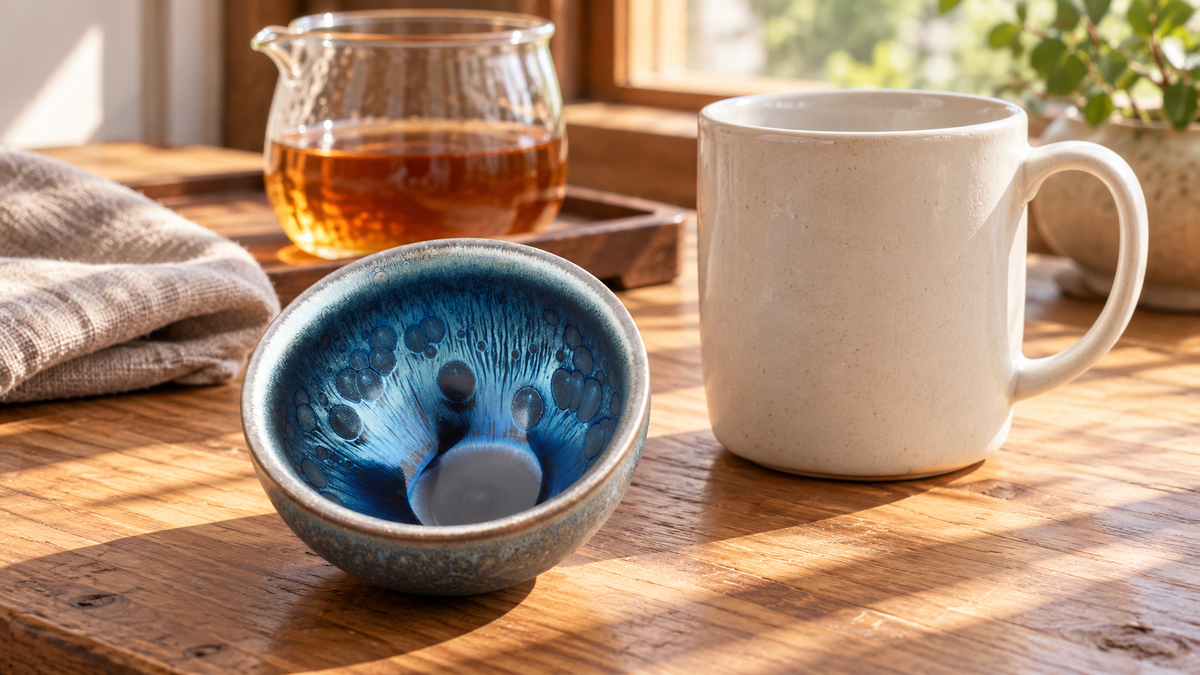
The Ocean Flow Tenmoku Ceramic Tea Cup is listed at 120 ml capacity and 9 cm diameter. Its blue glazed interior and handleless form make it a relevant example of a separate serving cup rather than a large, handled breakfast mug. Treat the listed volume as a product specification, not a recommendation to fill it to the edge.

It suits the small-pour side of this comparison if you are happy to keep a brewer nearby. It is not a direct substitute for a mug that holds your entire long drink. The product's current care fields mark it as unsuitable for microwave use and direct stovetop heat, so prepare the tea separately rather than using this cup to heat water.
The reason to choose this cup is its fit with your serving routine and your preference for its appearance. Its glaze does not establish that it will improve every tea, and a photograph cannot tell you exactly how comfortable it will feel in your hand. Compare the listed dimensions with a cup you already own before ordering.
Switching from a mug without buying a whole tea set
You do not need to replace all your teaware to try smaller servings. Keep a mug for busy mornings and use one small cup when you have time to sit down. If you already own a teapot or another suitable brewer, the first change can be just the drinking vessel.
- Prepare the tea in your existing brewer. Use the tea quantity, water temperature, and steeping time appropriate to that tea and your preference.
- Separate the leaves from the finished infusion. Remove an infuser or decant through a strainer as needed, rather than leaving unwanted steeping to continue while you drink.
- Pour below the rim. Leave enough space to lift and sip without spilling. Do not use the maximum stated capacity as a fill target.
- Keep the rest within easy reach. Place the serving vessel on a stable surface, away from the desk edge and anything that could catch its handle or spout.
- Refill when it suits you. Notice whether the smaller pours are pleasant or whether the repeated reaching interrupts what you are doing.
Try this at a time when you are not rushing. If you enjoy the cup during a ten-minute break but not during work, that is a useful result: both vessels can have a place. Buying a small cup does not require turning every drink into an elaborate ceremony.
Sharing tea: match the batch to the people
When two or more people share a pot, think about the amount of brewed tea you can actually pour and the comfortable serving in each cup. The brewer's nominal capacity may not equal its finished output because leaves occupy space and retain some liquid. Allow for that before deciding how many people one infusion will serve.
For example, if you have 180 ml of finished tea, two 90 ml pours divide it evenly. That arithmetic is an illustration, not a claim about the output of a particular teapot or the working capacity of every cup. Leave adequate headroom in each vessel and adjust the batch if someone wants a smaller portion.
You can use cups of different designs, but equal pours are easier to judge when their working capacities are similar. Do not buy a matching set solely to solve this; measure your existing cups first. For volume conversions and a fuller capacity comparison, use our tea cup sizes in ml and oz article.
What to check before ordering either vessel
- Preparation: Will tea steep in the drinking vessel, or arrive already brewed?
- Serving: Do you want one long drink or several small pours?
- Grip: Do you prefer a handle, and can you comfortably hold the filled vessel?
- Space: Is there room for a separate brewer and a safe pouring area?
- Care: Are the stated washing and heating limitations compatible with your habits?
- Contents: Is the listing for one cup, or does it explicitly include other pieces?
Read the selected product option as well as the photographs. A pitcher, cloth, tray, or mug shown in an editorial scene should not be assumed to come with the cup. Confirm the actual package contents on the listing before buying, especially when selecting something as a gift.
Material is another consideration, but it should not replace these practical checks. Heat behavior depends on the vessel's construction and the amount of tea, not simply whether the label says “cup” or “mug.” Our ceramic and glass teacup comparison covers that separate choice.
Common questions about tea cups and mugs
Can I drink tea from a coffee mug?
Yes, a clean mug intended for hot drinks can be used for tea. Check the maker's care limits and rinse away detergent or lingering residues. You do not need a different vessel solely because one drink is coffee and the other is tea.
Does a tea cup need a saucer?
No. Some Western tea cups are sold with saucers, while many small handleless cups are used without one. A suitable coaster or tray can protect the table and provide a place for drips, but check the actual listing rather than assuming a saucer is included.
Will a small tea cup make tea taste better?
Not automatically. Smaller pours change your drinking pace and the amount in front of you, which may suit your preferences. They do not fix oversteeping, an unsuitable water temperature, or tea you simply do not enjoy. Choose the cup for a comfortable experience rather than a promised flavor upgrade.
Is a mug equal to one measuring cup?
No. “Mug” describes a drinking vessel, not a standardized measurement. Use a measuring jug when a recipe needs a specific amount, and check the product's capacity when shopping. The volume you comfortably drink from can also be lower than its maximum fill.
Choose the routine first, then the cup
Keep a mug if convenience means brewing and drinking from one roomy vessel. Choose a small tea cup if you enjoy pouring from a separate brewer, sharing a pot, or sitting down for several short servings. Owning both is often more practical than asking either one to do every job.
For the small-pour option, compare Ocean Flow's dimensions with your current cup and decide whether frequent refills suit the way you drink. A well-matched purchase should make your existing tea routine easier to enjoy, without requiring accessories or habits you do not actually want.
Share:
Jianzhan Cup Shapes: Open, Flared and Inward-Curving Rims
Tea Tasting at Home: Choosing Cups and Comparing Teas