

Do not put a tenmoku-glazed cup in the microwave unless its maker explicitly permits microwave use for that exact piece. The name of a glaze, the colour of its surface, and a statement about kiln firing are not appliance-use approval. If the care information is missing, keep the cup out of the microwave and ask the seller for a product-specific answer.
That does not mean every cup described as tenmoku is unsuitable for every heating method. It means the category is too broad to answer the question on its own. For someone buying a cup for daily tea, the useful distinction is between a vessel for serving brewed tea and one explicitly approved for reheating it.
Is tenmoku glaze microwave safe?
There is no blanket yes that applies to all finished cups carrying that description. Check the whole product, not just the glaze name. A product page may discuss appearance, craftsmanship, or firing while saying nothing about microwave use. Those statements answer different questions. Do not turn missing information into permission.
The FDA's microwave oven safety advice recommends cookware specifically made for microwave use and following the appliance maker's operating requirements. Apply that principle to the actual cup you own. A general article about ceramics cannot approve an unidentified piece on behalf of its manufacturer.
For shopping, make microwave compatibility a separate checklist item. If reheating at work is essential, ask about it before placing an order. If you usually brew separately and pour small servings, a cup that stays out of the microwave may fit your routine perfectly well. The right purchase is the one whose documented use matches your habits.
What the available information actually tells you
| What you have | What it establishes | Practical next step |
|---|---|---|
| Explicit microwave permission for the exact cup | The maker permits the stated use, subject to its conditions. | Follow the cup and appliance requirements, including any limits. |
| A tenmoku or ceramic description only | A product category or finish description, not appliance approval. | Ask for confirmation and do not microwave while uncertain. |
| A high kiln-firing temperature | A statement about manufacture. | Check the separate finished-product care information. |
| A photograph with a reflective finish | How the surface appears under that lighting. | Do not identify composition or microwave suitability from colour. |
| Conflicting seller answers or a missing care card | The intended use remains unresolved. | Request one written answer tied to the product and variant. |
Why firing temperature is not the deciding detail
It is tempting to read a high firing temperature and conclude that a short microwave cycle must be harmless. But a manufacturing description is not a set of conditions for using the finished object in your kitchen. Keep those two pieces of information separate when comparing listings.
The same distinction applies to phrases such as handmade, traditional, or suitable for hot tea. None is a substitute for an explicit answer about the appliance you plan to use. Nor does a product's price settle the question. An expensive decorative cup and an inexpensive everyday mug should each be judged by their own stated care requirements.
When a listing spends several paragraphs describing production but leaves appliance use unanswered, send a short question rather than trying to interpret the story. Include the product link and selected option so the reply cannot accidentally refer to another cup in the same collection. Save the answer with your order details for later reference.
Reflective glaze is not the same as a verified material description
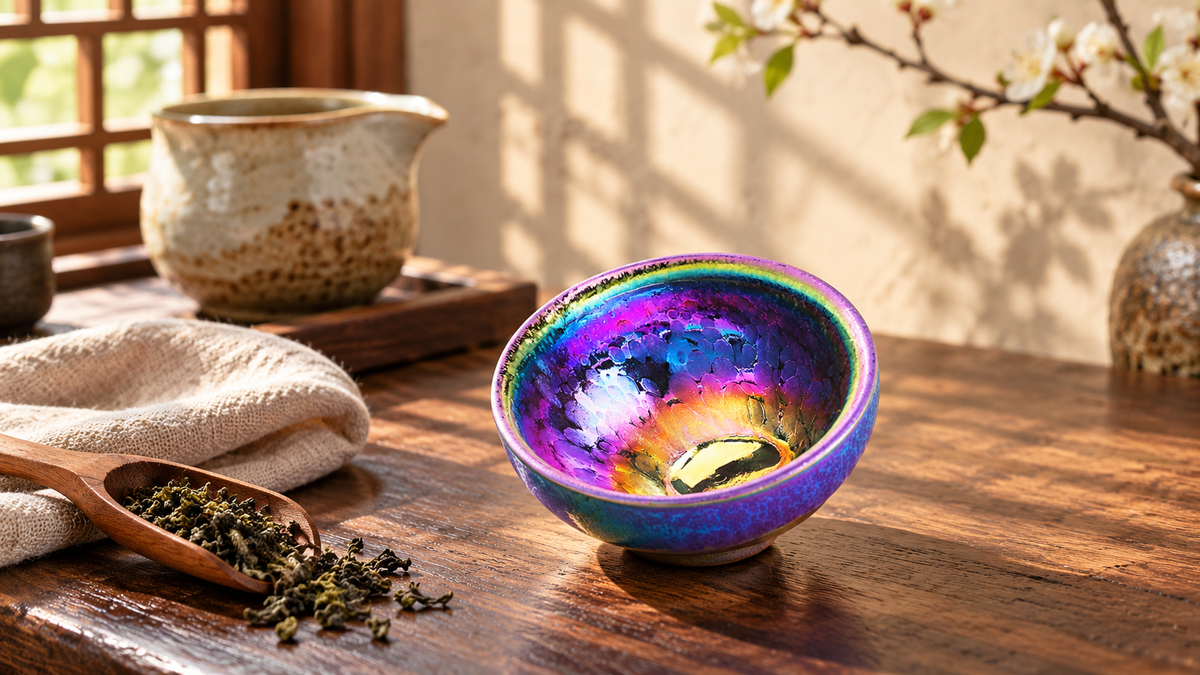
A rainbow sheen, gold-coloured patch, or silvery reflection may be the feature that attracts you to a cup. A photograph is useful for considering that appearance, but it is not a materials report. Avoid declaring that a cup contains metallic decoration, or that it contains none, solely because of the way the picture looks.
Actual metallic trim deserves a different question from a colour description. Panasonic's cookware advice notes that some ceramic decorations contain metallic paint that is unsuitable for microwave use. Ask the maker about any applied decoration and the finished cup's permitted use rather than treating every reflective glaze as identical.
This is particularly helpful when choosing a gift. A recipient should not have to infer care requirements from a colour name such as gold, silver, or rainbow. Supply the actual product information, and avoid adding your own appliance-safe label to the package.
A colourful serving-cup option, not a microwave claim
The Aurora Rainbow Tea Cup is an example of choosing a cup for its photographed finish and handleless shape. Its product images show purple, blue, green, and gold-coloured areas across the interior. Those visual features can be compared with the rest of your tea table without making a promise about appliance performance.

The product description checked for this article does not explicitly approve microwave use. We therefore do not present this cup as microwave safe. If you want it for an appliance-dependent routine, obtain confirmation for the exact item before buying. Its appearance is a reason to consider it for a tea setting, not evidence that it can replace a microwave-approved mug.
Look through the product photographs from several angles. Consider whether you like a handleless grip, how the opening fits your serving habits, and where the cup will sit between pours. If you need precise capacity or dimensions, check the current product details or ask the shop rather than estimating them from a close-up image.
Match the cup to the way you drink tea
Think through one ordinary tea break before comparing products. Do you brew a large mug and repeatedly reheat it? Do you pour from a separate pot? Do you share several short rounds with another person? These routines create different requirements, even when everyone describes the purchase as a tea cup.
- At a desk with frequent interruptions: if microwave reheating is part of the routine, choose a vessel with explicit approval instead of hoping a decorative cup will be compatible.
- At a tea table with a separate brewer: compare serving size, rim, grip, and the available space. Appliance use need not be the main buying criterion.
- For a shared kitchen: keep any special-care cup separate from everyday microwave cookware so its intended use is easy to remember.
- For a gift: check the recipient's habits. A beautiful cup that conflicts with their normal routine may spend more time on a shelf than at the table.
You do not need one vessel to perform every job. Keeping an explicitly approved reheating container and a separate serving cup can be a practical arrangement. Alternatively, choose one clearly documented everyday mug if convenience matters more than a particular finish. Either decision is better than buying first and trying to establish appliance compatibility afterward.
A tea routine that does not depend on reheating the cup
If you already brew in a teapot or another separate vessel, consider serving less at a time. Start with an amount you comfortably finish during the break and refill when you want more. This is a serving preference rather than a guarantee that any particular cup will retain heat longer.
Place the brewer and receiving cup close enough for a controlled pour, leaving a clear space for your hand. Keep the cup on a stable surface and leave room below the rim. A full-to-the-edge photograph is not a target for everyday use. The useful serving amount depends on the cup and the person holding it.
If the tea has cooled and you want it warmer, use equipment expressly suitable for that task and follow its operating requirements. Do not put an unapproved serving cup on a stove, warming plate, or other heat source as a substitute for the microwave. Permission for one use should not be extended to another.
The FDA also warns that overheated water in a microwave can erupt when disturbed. Avoid improvised heating times and use the appliance maker's stated method. This is another reason to keep reheating decisions separate from choosing a decorative serving cup.
Questions to send before buying
A precise question is easier for a seller to answer than “Is this cup safe?” The latter could refer to transport, hot drinks, machine washing, or several different appliances. Name the activity and the product so both sides are discussing the same thing.
- Is this exact product and selected variant approved for microwave use?
- Are there limits or conditions attached to that approval?
- Does the answer apply to any decoration, lid, or accessory included with my option?
- Where can I find the written care details supplied with the item?
- If microwave use is not approved, which intended uses does the maker specify?
For an older cup, include a photograph of the base and any identifying mark when contacting its maker. Do not assume that a current product with a similar name is the same item. If the maker cannot identify the piece or confirm its permitted use, keep it out of the microwave.
There is no need to experiment with an unknown cup to make a purchase decision. An improvised heating trial does not provide the same documentation as product-specific approval. Choose a documented alternative when microwave use is a requirement, rather than treating a lack of visible damage during one attempt as a lasting guarantee.
Buying more than one cup or choosing a boxed set
Check each component rather than assuming that a set shares one appliance permission. A cup, lid, tray, and decorative accessory can have different intended uses. Packaging does not make the collection a microwave-ready service, and a photographed prop is not necessarily part of the purchased contents.
When choosing several finishes, ask whether the care answer covers every selected variant. Keep the response with the order confirmation. For a gift, a simple card with the product name and care-page link is more useful than a broad statement about all ceramic teaware.
Browse the tea cups collection by shape and appearance, then check the individual listing before deciding. For comparing serving volumes, our teacup sizes in ml and ounces article separates smaller repeated pours from larger everyday servings.
Common questions
Can I microwave a tenmoku cup for only a few seconds?
A shorter time does not replace approval for the exact cup. If its maker has not permitted microwave use, keep it out of the appliance instead of choosing an arbitrary duration.
Does a gold-coloured glaze automatically mean metal trim?
No reliable composition claim follows from the colour name or photograph alone. Ask about the actual finish and the finished product's care requirements. Do not use appearance as a substitute for either answer.
Does dishwasher approval also cover the microwave?
Treat them as separate permissions. Look for an explicit statement about the appliance you intend to use rather than extending a different care claim.
What if I only want the cup for serving tea?
Check that its intended use matches serving tea, then compare the grip, opening, capacity, and finish. Microwave compatibility may be unnecessary for your routine, but that does not turn an unspecified cup into an approved reheating vessel.
Choose the finish you enjoy and the function you can verify
A distinctive cup can have a place at the table without doing every kitchen task. Choose the Aurora Rainbow Tea Cup for its actual photographed appearance if that suits your preferences, and confirm any essential care requirements before ordering. If microwave reheating is non-negotiable, put explicit product approval ahead of glaze colour or a manufacturing story.
Share:
Chinese Tea Gift Etiquette: Giving Cups and Sharing Tea
Jianzhan Cup Shapes: Open, Flared and Inward-Curving Rims