

Start with one tea cup for each person who normally drinks with you. For solo tea, one cup can be enough. For two regular drinkers, start with two. For a table of four, count the host as well as the guests and provide four cups. Add a spare only when your washing routine, visitors, or replacement needs justify it.
That simple starting point is more useful than buying the largest set you can fit into a shopping basket. A tea cup collection can grow gradually, but the cups you buy first should earn their place in an ordinary week. The decision depends on who drinks, how you serve, what you already own, and where everything will live afterward.
How many tea cups do you need for your usual tea table?
Count the people who will be drinking at the same time, not the total number of people who might visit during a month. A household with two tea drinkers and occasional dinner guests has different needs from someone who hosts a four-person tea session every weekend. There is no universal household cup count or compulsory matching set.
| Your usual situation | Starting cup count | When to add more | Buying priority |
|---|---|---|---|
| One person drinking at home | One | A second location or a useful spare | Comfortable rim and grip |
| Two people drinking together | Two | Regular visitors or separate workspaces | Serving amounts that suit both people |
| Host plus three guests | Four | A fifth place is genuinely used | Enough cups and manageable storage |
| Six people at a tea table | Six | A replacement or extra attendee is likely | A practical way to divide each brew |
These are practical starting quantities, not rules of tea etiquette. If your existing cups already cover the people at the table, you may not need a new set at all. Replace an unsuitable piece or fill a specific gap rather than duplicating an entire service.
Buying one tea cup for yourself
A single cup makes sense when you brew separately and drink alone. You can choose the shape you enjoy without needing to coordinate with five other pieces. It also lets you assess a new style in daily use before committing shelf space and money to several cups.
Think about the details that a close-up photograph cannot settle for you. Is the opening comfortable? Does a handleless bowl suit the way you hold a cup? Can you set it down securely in the place where you normally drink? Compare the listed dimensions with something you already own rather than judging scale from a styled image.
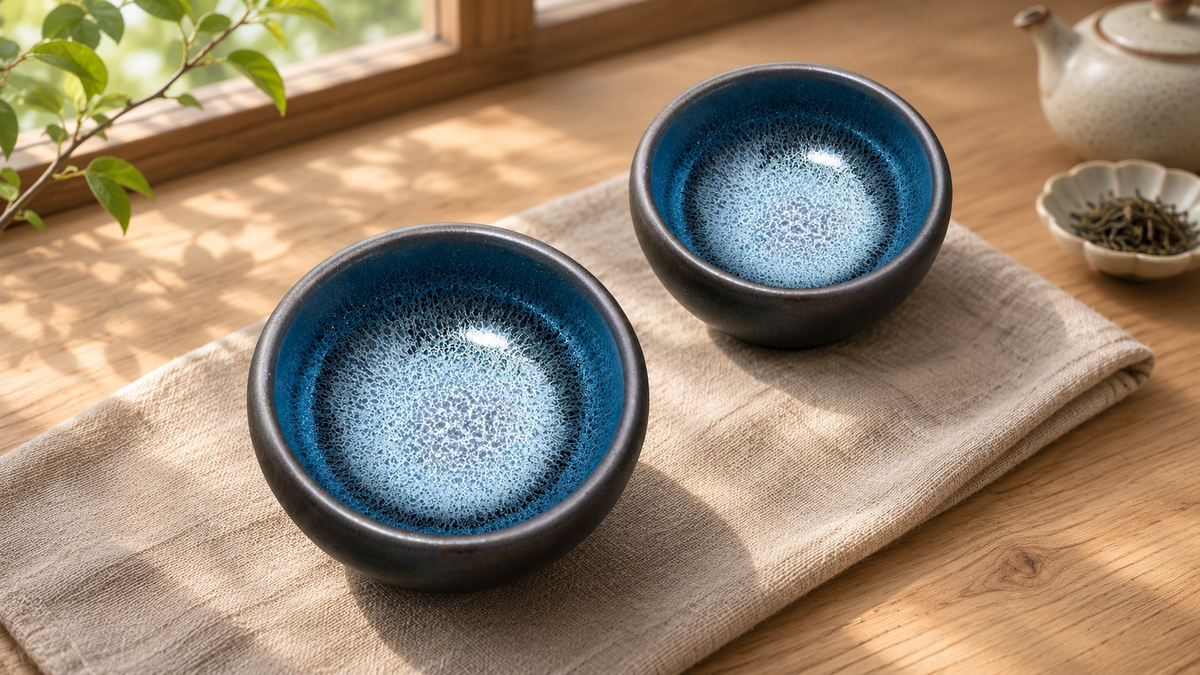
The Blue Kirin Zen Jianzhan Teacup is a single-cup option with a listed capacity of 110 ml, diameter of 8.5 cm, and interior depth of 5 cm. It suits consideration as an individual serving cup, rather than a large mug. Its blue-toned glaze and rounded profile are the visual reasons to compare it with your existing teaware.

Buying two of a single-cup product means ordering two units unless the selected listing explicitly says otherwise. A lifestyle photograph showing a pair is not a packing list. Check the selected option and order quantity before completing the purchase, particularly when a shop uses several cups to show different angles of the glaze.
Two people: a pair without a full tea service
For two people sharing tea, two cups are the direct starting point. They do not have to be identical. One person may prefer a wider opening, while the other likes a smaller bowl. The useful question is whether both cups work with the way you divide and drink the tea.
If you usually pour equal portions, cups with similar usable volumes make that easier to judge. Different shapes can make equal amounts look surprisingly different, so do not use the apparent fill height as your only reference. You can compare the cups with room-temperature water before the first shared session.
A pair of individually selected cups can also be a more personal purchase than a larger boxed set. Each person can choose a finish they enjoy, while the household keeps the total number manageable. Conversely, a coordinated pair may be simpler if you value a consistent table setting and want the cups to feel similar in use.
- Count both regular drinkers before adding optional spares.
- Check that each person likes the rim and grip, not just the colour.
- Keep enough table space for setting each cup down between pours.
- Confirm whether the seller offers individual replacements or only a complete set.
Hosting: count seats, including your own
When buying cups for guests, start with the gathering you actually host. Three guests plus you means four drinkers. Six guests plus you means seven. It is easy to buy a four-cup set for “four guests” and leave the host without a cup.
For occasional larger gatherings, check the cups already in your cupboard before ordering more. A mix of suitable pieces can be perfectly practical for an informal afternoon. If a coordinated appearance matters to you, build toward your regular table size instead of purchasing for an exceptional event that may happen once a year.
One spare can be useful if you regularly add an unexpected seat or want a backup while another cup is being washed. Several spares may simply become unused storage. Keep the reason specific: an extra attendee, a separate room, or a replacement plan. “The set was larger” is not necessarily a reason you need every piece.
Cup count and the amount of tea in each round
Owning four cups does not mean your brewer will fill four cups to their stated capacity. Separate three quantities: the brewer's advertised capacity, the amount of brewed tea you actually pour out, and the serving amount you want in each cup. They are not interchangeable.
For example, if you measure 180 ml of brewed tea in a sharing pitcher and divide it equally among three people, each serving is 60 ml. The receiving cups can be larger than that. A 110 ml cup does not need to receive 110 ml every time, and leaving space below the rim makes a pour easier to handle.
If the same 180 ml is shared among six people, the serving becomes 30 ml per person. Decide whether that fits the occasion. Some tables enjoy small repeated pours; others prefer a larger drink before refilling. You can change the serving rhythm without automatically replacing all the cups.
For a simple check, measure your usual finished brew with a measuring jug, divide it by the number of drinkers, and compare that amount with a comfortable fill in each cup. Do not assume the brewer's labelled capacity is the finished volume available after brewing. For a broader capacity comparison, see tea cup sizes in ml and oz.
When a four-cup set makes sense
A set is useful when its actual contents match a recurring need. Four cups can serve a four-person table, or provide a two-person household with a pair for visitors. The advantage is getting the intended group together, not a promise that buying more cups automatically improves the tea.
The JianZhan Tenmoku Four Seasons Tea Set contains four tea cups. Each is listed at 110 ml, with a height of 4.2 cm and width of 9 cm. Its different seasonal colours offer a coordinated group without requiring every cup to look identical.

Consider it as a cup group, not as proof that a brewing vessel or every photographed accessory is included. The name “tea set” can describe quite different combinations across shops. Read the item list before comparing it with another offer that includes a teapot, tray, or serving pitcher.
Single cups versus sets: compare what you will use
Individual cups offer flexibility. You can start with one, choose different finishes, and add another when your routine changes. The tradeoff is that the same design may not remain available forever. If an exact match matters, ask about replacement availability rather than assuming you can always complete the group later.
A set offers a defined group in one purchase. It may simplify choosing cups for regular guests, but compare its total cost with the number of cups you genuinely need. A lower apparent price per piece is not automatically better value when half the pieces remain unused.
Compare current prices, included quantities, and delivery charges at the time you order. Do not compare a single-cup price with a whole-set price as if they represented the same purchase. Also check whether a pictured colour is the selected option or one of several alternatives.
Storage can decide the right quantity
Measure the shelf or tray where the cups will live. Cup width matters here as much as capacity. Allow space to lift one cup without knocking the next, and avoid buying a group that only fits when the rims are pressed tightly together.
Do not assume rounded ceramic cups are designed to nest or stack. Check the maker's care details and the actual fit. If cups touch when stored, a suitable soft separator can reduce direct contact, but it does not make an unstable stack secure. A low, accessible shelf is often easier to use than a crowded display.
Your cleaning routine matters too. If you wash and dry your cup after each break, one may work well. If cups are used in different rooms or by several people throughout the day, an additional cup may solve a real inconvenience. Buy for that routine rather than using a fixed multiple for every household.
A short checklist before adding cups to your basket
- Count the people who usually drink at the same time, including the host.
- Count suitable cups you already own and subtract them from that need.
- Check your actual brewed volume and preferred serving amount.
- Confirm whether the product contains one cup, a pair, or a larger group.
- Compare dimensions with your hands, table, and storage space.
- Check current price, selected option, care details, and any essential accessories.
- Add a spare only when you can name the job it will do.
Common questions about buying tea cups
Do I need six cups to start drinking gongfu tea?
Not for a solo routine. One receiving cup can serve one person, while a shared session needs a cup for each drinker. Choose the quantity for your table rather than treating a six-cup photograph as a mandatory starter kit.
Can I use different cups for guests?
Yes, a matching appearance is a preference for an informal table. Check that the cups suit hot tea and your serving amounts, and consider each guest's comfort. Different colours can also make it easier to keep track of whose cup is whose.
Is a four-cup set enough for two people?
It can cover the two regular drinkers and two visitors, but you do not need four simply because you drink as a pair. Two cups are a reasonable start when guests rarely join you and storage is limited.
Should I buy the cup first or the full set?
If you are uncertain about a shape, a single cup lets you try that style with less commitment. If you already know what works and regularly serve several people, a set with the right contents may be simpler. Either way, choose for a real use rather than a hypothetical collection.
Buy for the next ordinary tea session
Begin with the people and equipment already at your table. A Blue Kirin single cup can fill an individual place; the Four Seasons four-cup set offers a group for sharing. Neither quantity is automatically the better choice. The useful purchase is the one that fits your serving routine, feels comfortable to use, and has a place to go after the tea is finished.
Share:
Are Tenmoku Tea Cups Durable? Everyday Use, Chips and Cracks
How to Pack a Ceramic Tea Cup for Travel