


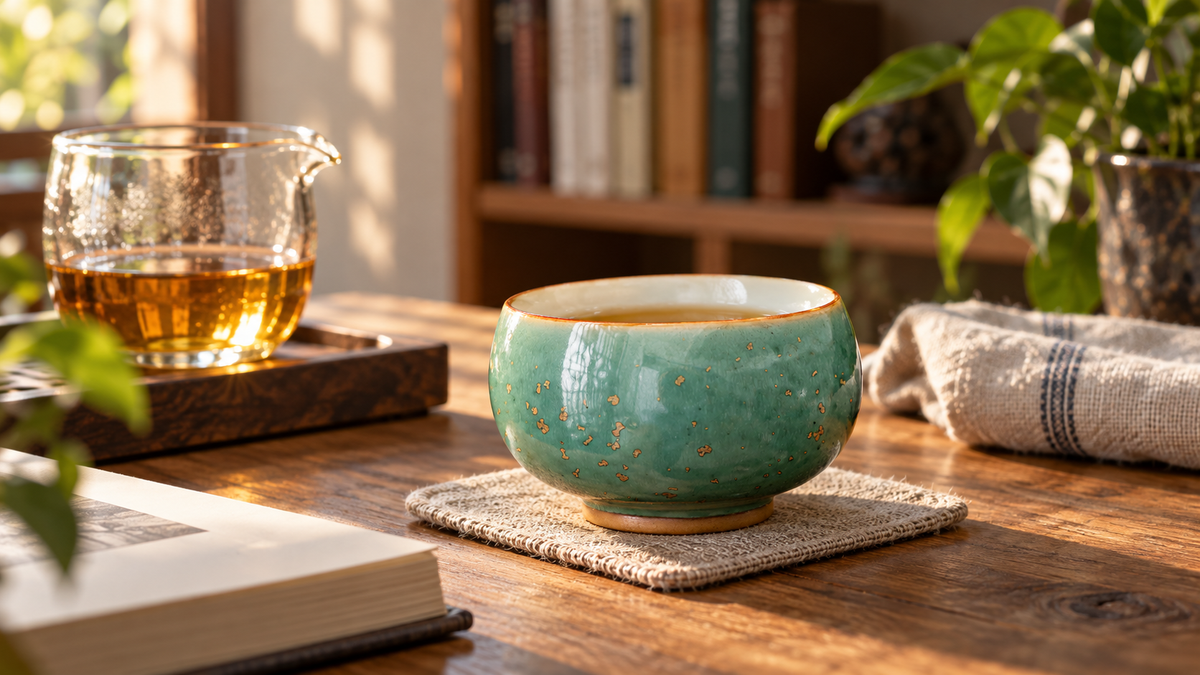
A small ceramic tea cup can change the rhythm of an ordinary tea break. Instead of filling a large mug and leaving it beside your keyboard, you pour a little tea, take a few sips, and return to the pitcher when you want more. The cup becomes part of a simple routine rather than another object taking up space on the desk.
Making that routine work depends on practical details: how much you actually drink at once, whether the cup is comfortable to lift, how it fits your brewing vessel, and how easily you can wash and store it. This guide focuses on choosing and caring for a small everyday tea cup, with the Green Glaze Gold Spot Tea Cup as a concrete example. Its compact size and distinctive finish offer a useful starting point for thinking about your own preferences.
Start with the way you drink tea
Before comparing glazes, picture your usual tea break. Do you sit down with a teapot for ten minutes, share several infusions with a friend, or carry one drink between meetings? These are different situations. A small handleless cup may suit the first two beautifully, while a larger handled vessel may be more convenient for the third. There is no need to make one cup perform every job.
If you brew loose tea in a separate pot or gaiwan, a small serving cup gives you a place to enjoy each pour without leaving the leaves in your drink. If you normally steep a tea bag directly in a large mug, moving to a compact cup also means changing your preparation routine. Plan for a separate brewing vessel or pitcher rather than assuming your existing method will fit unchanged.
- For a quiet personal session, consider whether you enjoy frequent small refills.
- For shared tea, match the number of cups to the amount of brewed tea available.
- For desk use, allow space for a stable coaster and a pitcher away from electronics.
- For a gift, choose around the recipient's habits rather than your own favorite shape.
A helpful first step is to measure one serving from the cup you already use. You may discover that your usual pour is much smaller than the vessel's full capacity. That observation is more useful than selecting a new cup from a photograph alone.
Read capacity and dimensions together
A capacity number tells you how much a cup is listed to hold, but it does not describe the complete experience. Diameter affects the space it occupies and how you hold it. Interior depth helps you understand the bowl inside. The curve of the walls and the shape of the foot affect its appearance and handling. Read these details together before deciding whether a cup is genuinely compact enough for your tray.
The Green Glaze Gold Spot Tea Cup is listed at approximately 110 mL capacity, 6.6 cm diameter, and 4.9 cm interior depth. That last measurement refers to the depth inside the cup, not its overall exterior height. It is a small serving cup, not a replacement for a large breakfast mug. Leave comfortable space below the rim when pouring instead of treating the listed capacity as a required serving size.
You can make a simple size check at home without special equipment. Mark a circle approximately 6.6 cm across on a piece of paper and place it where the cup would sit. Then measure 110 mL of water in a kitchen measuring jug to understand the listed volume. These checks do not reproduce the cup's exact shape, but they make the numbers easier to relate to your table and drinking habits.
| Detail to compare | Green Glaze Gold Spot example | What it helps you decide |
|---|---|---|
| Listed capacity | Approximately 110 mL | Whether small, repeated servings match your routine |
| Diameter | Approximately 6.6 cm | How the cup fits your hand, coaster, and serving tray |
| Interior depth | Approximately 4.9 cm | The depth inside the cup; this is not exterior height |
| Finish | Green-toned glaze with gold-toned spots | Whether the color and surface detail suit your existing teaware |
| Serving arrangement | Brew separately, then pour into the cup | Whether you also need room for a pot, gaiwan, or pitcher |
Look closely at the rim, body, and foot
Product photographs are useful when you look beyond the overall color. Examine the rim from the side, the opening from above, and the base from below when those views are available. A single dramatic photograph can make a cup look larger or flatter than it really is. Several angles give you a better understanding of the proportions.
In the product photograph below, the rounded green body, pale interior, warm-toned rim, and small foot are visible together. These are visual details to compare with your preferences. The gold-toned spots describe the appearance of the finish; the name alone does not establish that the decoration contains actual gold. Glaze pattern and color can also vary slightly from cup to cup, as noted on the product page.

For a handleless cup, think about where your fingers will rest and whether you prefer holding a round body or using a handle. Neither choice is automatically more comfortable for everyone. If easy handling is your main concern, compare the dimensions with a familiar cup and ask for any missing measurements before ordering. A photograph cannot tell you the weight or the exact feel in your hand.
Match the cup to your brewing setup
A well-matched tea setup does not require every piece to come from the same collection. It requires enough room to pour, a comfortable amount of tea for the people drinking, and a clear place to set each vessel down. Begin with what you already own. A compact cup can work beside a plain glass pitcher or a simple ceramic pot without buying an entirely new set.
Think in terms of usable brewed volume rather than the maximum capacity printed on your teapot. Leaves occupy space, and you may not fill the pot completely. For example, if you have 180 mL of brewed tea to share between two cups, an equal division would be 90 mL each. This is a planning example, not a recommended fill level for every cup. Check the actual space below the rim and pour less when that is more comfortable.
For solo use, a pitcher gives you the option to serve one small portion at a time. Keep the cup within easy reach, with the pouring vessel farther from the desk edge. If you are building your first setup, our tea cup selection guide offers a broader starting point. Here, the main question is narrower: will this size fit the way you want to spend an ordinary tea break?
A simple first-use routine
When a new cup arrives, take a moment to examine it before arranging your first session. Check the rim and body for shipping damage, place the cup on a flat surface, and compare the item with the product description. Keep the packaging until you have finished that inspection. If something looks wrong, photograph it and ask the seller before using the cup.
- Wash the cup gently with mild dish soap and a soft sponge, then rinse thoroughly.
- Set it on a clean, stable surface and make sure the base is dry.
- Brew your tea separately using your preferred method.
- Pour a modest amount, leaving space below the rim.
- Check that the cup and tea are comfortable before lifting and sipping.
- Empty, rinse, and dry the cup after the session.
Keep the first session straightforward. You do not need an elaborate ceremony or a complicated preparation ritual to enjoy a new cup. A familiar tea is useful because you can pay attention to the cup's handling and serving size without also learning a new brewing method. Adjust the amount you pour over the next few sessions until the routine feels natural.
Clean gently and make drying easy
The easiest cleaning routine is one you can repeat after every use. Empty leftover tea, rinse the cup, and use a soft sponge with mild dish soap when washing. Rinse away soap thoroughly and allow the cup to dry before putting it into a closed cupboard or box. The product page specifically recommends rinsing after use and drying thoroughly.
Set aside abrasive pads and metal scraping tools for this task. If a mark remains, avoid escalating immediately to a harsh cleaner or an improvised treatment. Ask for care guidance appropriate to that particular finish. A routine that works for a plain kitchen mug should not automatically be applied to every decorative ceramic cup.
Do not assume dishwasher or microwave compatibility from the material name or product photograph. If those features matter to your routine, confirm them for the exact product before purchase. Until you have that guidance, hand washing and brewing or heating your drink in a separate suitable vessel keep the routine simple. Avoid sudden changes between very cold and very hot conditions.
Store a small cup where you will actually use it
A beautiful cup is easy to forget if it lives behind a stack of oversized mugs. Give your everyday cup a convenient place near the rest of your tea equipment. Leave enough space to lift it without knocking another rim, and make sure the shelf or tray is dry. Storing fewer pieces together can make a small tea corner easier to maintain.
Avoid forcing rounded cups into tight stacks unless their design is intended for stacking. For occasional storage in a box, let the cup dry completely first and keep the rim protected from hard objects. If you move your tea setup between rooms, carry the vessels on a stable tray rather than balancing several filled cups in your hands.

Choose a gift around the recipient's routine
A small tea cup can be a thoughtful gift for someone who enjoys a separate brewing pot, repeated infusions, or a quiet moment at a tea tray. It may be less suitable for a person who wants one large drink to take on the commute. Start with that practical distinction before choosing a color or finish.
Check the listing for what is included rather than treating everything in a styled photograph as part of the purchase. A pitcher, cloth, tray, or book in a scene can be a prop. Gift packaging, cup quantity, and accessories should be confirmed in the product or variant description. If the presentation matters, ask about it before ordering rather than assuming a single cup includes a gift box.
You can make the gift feel more personal with a short note suggesting a quiet tea break or describing why you chose that finish. There is no need to promise a special effect on the tea. The useful gift is a cup that matches the recipient's habits and gives them a reason to enjoy those habits more often.
Your final everyday tea cup checklist
- Does the listed capacity suit the amount you like to drink in one serving?
- Have you checked diameter and interior depth instead of judging size from the photograph?
- Will you brew separately, and is there room for that vessel?
- Does the shape suit your preferred way of holding a cup?
- Are the care requirements compatible with your routine?
- Have you checked the actual package contents and any options before ordering?
If you want a compact cup for small pours, the 110 mL Green Glaze Gold Spot Tea Cup is worth comparing with your current setup. Review its product photographs and dimensions, then decide whether you would enjoy using it on a normal weekday, not only on a special occasion. A successful choice is one that feels easy to reach for, pleasant to use, and straightforward to care for.
Share:
Is a Matcha Bowl Lead Free? What to Check Before Buying