

A gaiwan and a teapot can both brew loose-leaf tea, but they ask different things of your hands. A gaiwan uses a bowl and an adjustable lid gap to retain leaves while pouring. A teapot adds a handle, a defined spout and some form of outlet. Choose between them by the way you want to make and serve tea, not by a claim that one always produces better flavor.
For someone who likes seeing the leaves and changing the opening during a pour, a gaiwan can be appealing. For someone who prefers a familiar handle and a directed stream, a teapot may feel more comfortable. Either can suit repeated small infusions when its working volume matches the cups at the table.
Compare the actual vessels, not two entire material categories
Many comparisons place a porcelain gaiwan beside an unglazed clay teapot. That comparison changes both the form and the material. It cannot prove that every difference comes from the presence of a handle or spout. A thick bowl and a thin pot also behave differently from a thin bowl and a thick pot. Fill level, room conditions and brewing method matter.
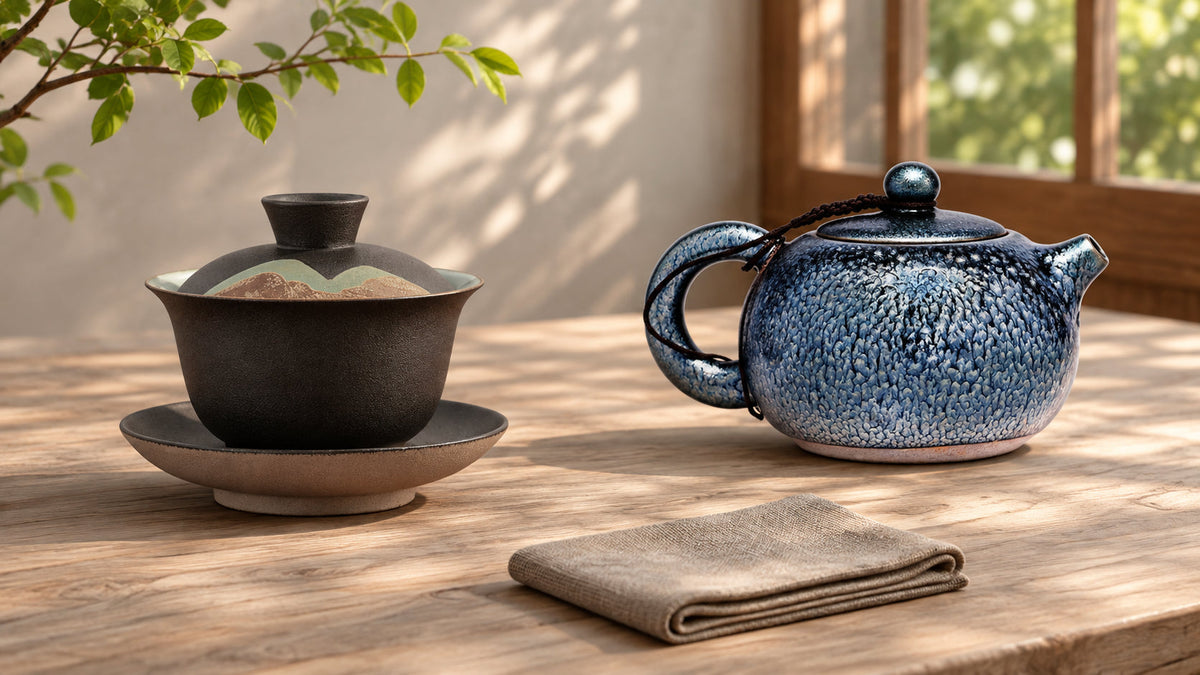
This article focuses on the practical differences between a lidded brewing bowl and a handled teapot. The ARTTEACUP examples are the Mountain Serenity gaiwan and Petal Flow teapot. Their photographs show different shapes and surfaces, but they are not a controlled test of heat retention, tea flavor or manufacturing quality. Neither is presented as a substitute for a kettle.
What changes at the moment of pouring?
| Decision | Gaiwan | Teapot |
|---|---|---|
| Holding the brewer | Rim and lid control depend on the shape and chosen grip | Handle provides a separate gripping point |
| Keeping leaves back | Adjustable opening between bowl and lid | Outlet holes or an infuser depending on the exact pot |
| Seeing the leaves | Wide opening is easy to inspect when the lid is removed | Visibility depends on the lid opening and body shape |
| Directing the stream | Comes from the bowl rim through the lid gap | Comes from a shaped spout |
| Cleaning access | Open bowl gives direct access | Opening and outlet design determine access |
| Main purchase check | Comfortable rim span and controllable lid | Balanced grip and manageable spout and lid |
None of these features guarantees an easy pour. A gaiwan with an awkward lid can be frustrating, and a teapot with an uncomfortable handle can be tiring. The most relevant comparison is between the exact pieces you are considering and a vessel you already find comfortable.
Mountain Serenity: a lidded bowl with a clear visual outline
The Mountain Serenity Ceramic Gaiwan photographs show a dark bowl, a contrasting mountain design on the lid and a matching saucer. The outward-moving rim and central lid knob are the areas to inspect when considering how you would lift and tilt it. Choose the intended color option rather than assuming every gallery image represents the same selection.

The bowl's opening makes it possible to inspect the leaves without looking through a narrow neck. You can remove the lid between infusions when that suits your brewing routine. However, the open view does not establish a safe grip or a measured output. Check current dimensions and ask about working capacity if you are planning around specific drinking cups.
A photograph cannot establish that a rim or knob stays cool. Before brewing with a new gaiwan, practise the handling over a sink with cool water and a modest fill. If the movement feels uncertain, choose a more familiar brewer rather than forcing a hot-water technique. Decorative appeal should not override comfortable control.
Petal Flow: a handle and spout change the movement
The Petal Flow Blue Tenmoku Ceramic Teapot has a rounded body, a loop handle, a separate lid and a short spout. Its blue and pale surface markings give it a different visual presence from the quieter Mountain Serenity bowl. These are separate products, not a combined set.

A loop handle gives you a dedicated place to lift the body, while the spout directs the stream. That can feel familiar if you already use a small pot. Still, compare the space inside the handle, its distance from the body and the overall width including the spout. A compact body does not necessarily mean a compact footprint.
Check the outlet and lid in the current listing before deciding whether an additional strainer is useful. Do not infer the internal filter from the exterior photograph. Ask for an inside view or a pouring demonstration if that feature will determine the purchase. A beautiful glaze is not evidence of a drip-free spout.
Use the tea leaves to narrow the choice
Large, relatively intact leaves can be manageable with a gaiwan lid gap, but fragments may still escape. A small opening can retain more pieces while slowing the pour. A larger opening can empty faster while letting more fragments through. The practical balance depends on the leaves and your control of that particular lid.
With a teapot, the outlet limits change differently. Small holes may retain leaves but can be covered by them. A removable basket may simplify emptying, yet its dimensions determine how much room the leaves have. These details are more useful than a rule that a gaiwan suits all loose tea or that a teapot automatically filters everything.
If you dislike any fragments in the drinking cup, consider a separate, suitable strainer over the receiving vessel. Make sure it sits securely and has enough flow for the pour. Do not hold an unstable strainer over someone's cup while handling hot tea with the other hand.
Match the output to one person or a shared table
Start with the quantity you want to drink in one round. If you prefer one small cup at a time, a large brewer may create an awkward surplus. If you regularly serve two people, a brewer that delivers only one person's comfortable portion may force you to combine separate infusions. Neither problem is solved by the word gongfu on a product page.
For example, two illustrative portions of 35 ml require about 70 ml of finished tea. That is a serving calculation, not a capacity claim for either featured product. Leaves occupy space and retain liquid, and a comfortable fill may sit below the maximum quoted by a seller. Ask how a stated capacity was measured if it is close to your minimum requirement.
A fairness pitcher can receive the full infusion before sharing. Without one, the receiving cup or cups must accommodate what you decant. Do a cool-water capacity check with your existing cups before planning the first hot session. Leave room below their rims rather than treating maximum capacity as a serving target.
Temperature is a whole-setup question
A lid, exposed surface area, wall thickness and the amount of water all affect a brewing vessel's temperature behavior. Prewarming changes the starting condition. A comparison that ignores those factors can make shape seem more decisive than it is. There is no reliable basis here for promising that the featured pot always stays hotter than the featured gaiwan.
Follow the recommendations for the tea you are preparing, then adjust one variable at a time if the result is not to your taste. A gaiwan gives convenient access to the leaves, but opening it also changes the environment inside. A teapot can keep the leaves enclosed, but a small fill in a large body is not the same as a full working batch.
Cleaning and daily handling may settle the choice
An open bowl is straightforward to inspect after emptying. A pot needs attention around the outlet, under the lid and inside any removable components. These are differences in access, not proof that one form is always hygienic and the other is not. Choose a shape you can empty and clean comfortably after an ordinary session.
Consider the return journey to the cupboard. A gaiwan has separate bowl, lid and saucer components that need secure resting places. A teapot has projecting parts that need protection from knocks. Dry the pieces appropriately before storage and keep rims from pressing against neighboring ceramics. Check the care details for the exact item rather than carrying appliance assumptions between products.
A simple choice for three common routines
- You want to inspect leaves and adjust a lid gap: shortlist a gaiwan whose rim and knob feel manageable.
- You prefer a handle and a defined stream: shortlist a teapot with a comfortable balance and accessible outlet.
- You want one large drink with minimal handling: compare an appropriate infuser arrangement as well; neither small brewer is automatically the simplest answer.
Use a familiar cup to compare size, not your memory of a dramatic tea video. The gaiwan collection and teapot collection offer different outlines to consider. Select the one that solves a real handling need before matching its colors to the rest of the table.
Try a realistic first week
Imagine making tea on an ordinary weekday, not on the afternoon when you have unlimited time. If you would leave a gaiwan unused because managing the lid feels demanding, a familiar teapot may be the more useful purchase. If you enjoy attending closely to short infusions, the open bowl may be exactly the feature you want. Neither preference needs a claim about superior taste to justify it.
Keep your first arrangement small. Use the cups you already own, note one inconvenience after several sessions and address that specific issue before adding more pieces. Perhaps the brewer is comfortable but the receiving cup is too small; perhaps the lid needs a better resting place. Those observations produce a more precise next purchase than replacing the entire setup because a video uses another brewing form.
Can a gaiwan also be a drinking cup?
Yes. A gaiwan is not exclusively a decanting tool. Tea Guardian describes using it directly as a cup, as well as the importance of the lid and saucer arrangement. That does not mean every modern gaiwan is equally comfortable for that use. Decide whether you intend to sip from it or pour into separate cups, then check the exact shape accordingly.
The best first choice is the vessel you can handle confidently, empty into suitable cups and clean without frustration. Mountain Serenity illustrates the open lidded-bowl arrangement; Petal Flow illustrates the separate handle and spout. Their visual differences make the choice personal, while working capacity, grip and pouring control make it practical.
Share:
Why Do Glazed Tea Cups Look Different in Photos?