

A small tea cup can serve espresso if it is intended for hot drinks, holds your finished serving with room to spare, and feels secure in your hand. The name on the listing is not the deciding factor. A cup that works beautifully for several small pours of tea may still be awkward under a coffee machine or uncomfortable to lift immediately after brewing.
Tea cups and espresso cups overlap, but they are not interchangeable in every situation. The useful questions are practical: how much liquid arrives, how wide the drinking edge feels, where your fingers go, and whether you want to wash one cup between drinks. Start there before buying a second set of cups.
Tea cups vs espresso cups: where the difference matters
“Tea cup” covers several very different forms. A handled porcelain cup used with a saucer is not the same shape as a small handleless cup used for repeated tea infusions. Comparing every tea cup with one standard espresso cup therefore produces misleading rules about which is bigger, wider, or thicker.
An espresso cup, also called a demitasse, is intended for a short coffee serving. Many are compact and handled, although handleless versions also exist. A small Chinese tea cup can occupy similar shelf space while having a much wider opening. That difference changes the depth of the liquid and the experience of lifting and sipping, even when both cups can hold the drink.
Neither label guarantees a particular material, temperature performance, or flavor. Compare the actual vessels. A wide tea cup is not automatically unsuitable for coffee, and a narrow espresso cup is not automatically unsuitable for tea. The question is whether the tradeoffs match the way you drink.
| Check | Small handleless tea cup | Compact espresso cup | What to do before buying |
|---|---|---|---|
| Finished serving | Often used for repeated small pours | Usually chosen around a short coffee | Allow space for the drink, crema, additions, and movement |
| Opening and rim | May be broad, flared, or inward-curving | Often relatively compact, but designs vary | Compare with a cup whose sipping edge you already like |
| Grip | Fingers contact the cup body | A handle may provide a separate gripping point | Check comfort with a warm, partially filled cup |
| Machine clearance | A low bowl may still have a wide footprint | A familiar shape does not guarantee fit | Measure external height, base support, and space below the spouts |
| Switching beverages | Suitable care and a clean interior matter | Coffee oils and milk still need washing away | Check washing limits and whether odors remain after cleaning |
Match the cup to your actual espresso serving
Do not choose a cup just because a product photograph shows a tiny coffee. Your finished drink depends on the recipe or machine setting you use. A short espresso, a longer extraction, and a coffee with milk need different amounts of space. Capsule machines can also deliver different volumes under similar drink names.
Check the output of your usual setting in a vessel that comfortably contains it. If you normally add milk or water, include that too. Then choose a cup that leaves a useful margin below the rim. A stated capacity is not a promise that the cup will be pleasant to carry when filled to that amount.
For example, a cup listed at 50 ml is not a comfortable container for a full 50 ml coffee. A smaller serving might fit, but crema and the space needed for lifting still matter. Do not choose this size for a double espresso, a long coffee, or a milk drink without checking the actual finished volume. Nominal capacity alone says nothing about grip or machine fit.
Espresso recipes are frequently measured by weight. Do not assume a number in grams will occupy exactly the same number of milliliters, particularly when fresh crema is present. Leave room rather than trying to fill to a calculated edge. For a broader volume comparison, see our tea cup capacity chart.
Look at the rim, not just the capacity
Imagine pouring the same short serving into a narrow cup and a broad bowl-shaped cup. In the broader vessel, the coffee spreads across a larger area and appears shallower. Some drinkers enjoy that presentation; others prefer the more concentrated-looking pool in a compact demitasse. Neither appearance proves that the coffee has been brewed better.
A flared edge, a straight wall, and an inward-curving rim can feel different against the lips. Product photographs can show the shape, but they cannot establish your personal comfort. Measure the opening of a cup you already enjoy and compare it with the listing. This is more useful than choosing solely by a decorative glaze or an attractive coffee photograph.
Temperature behavior also depends on construction, starting temperature, serving size, and time. Avoid a universal rule that all tea cups cool quickly while all espresso cups keep drinks hot. If you like a leisurely coffee, compare the two cups under your own routine. If you finish a short serving promptly, grip and rim comfort may matter more to you than a small temperature difference.
A tea-first example: Starry Flow's 50 ml cups
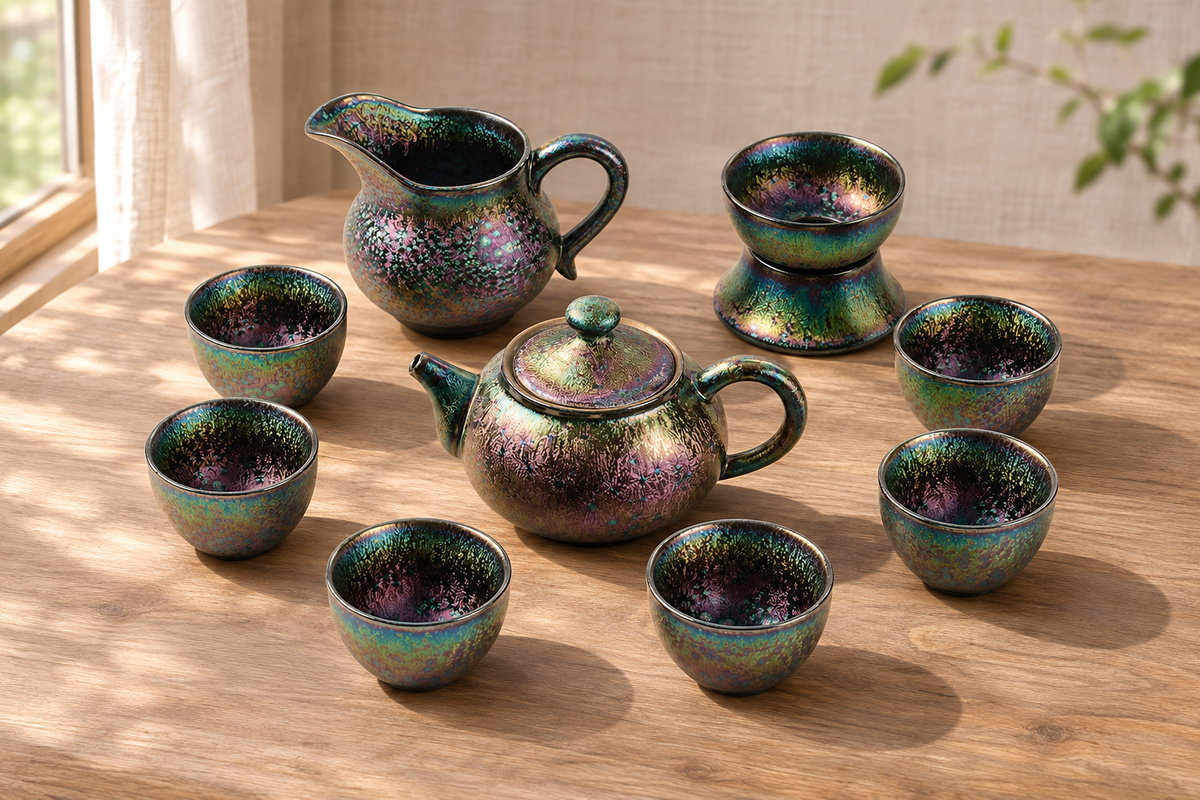
The Starry Flow Tenmoku Ceramic Tea Cup Set contains six small handleless cups with a dark, multicolored glaze. Each cup has a stated capacity of 50 ml, a width of 6 cm, and a height of 4.2 cm. These are small tea-serving vessels, not large coffee cups, and the capacity makes their limitations particularly important.
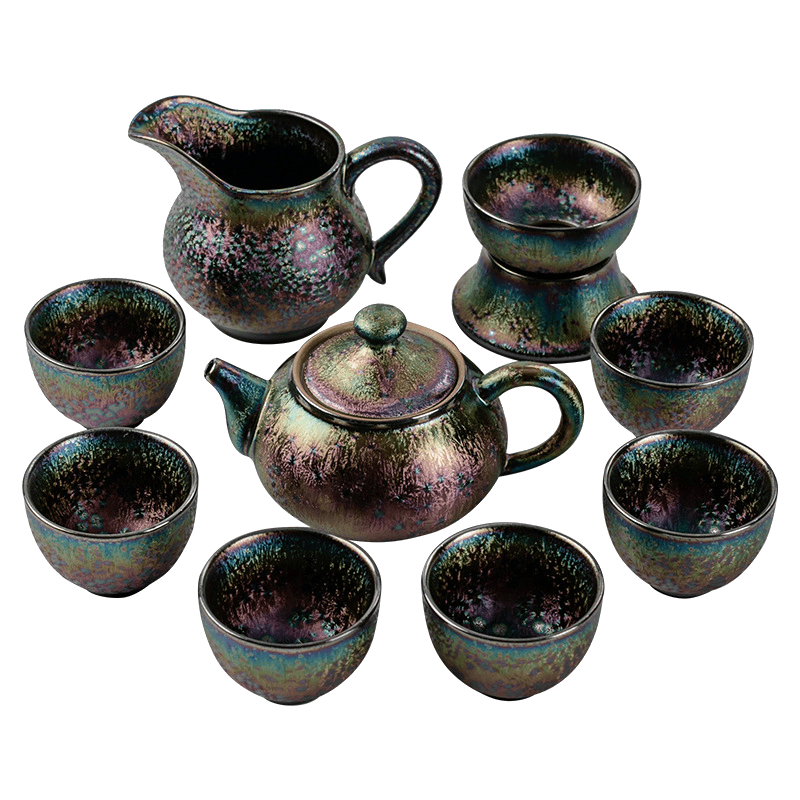
The set also includes a 220 ml teapot, a 190 ml serving pitcher, and a tea strainer with its stand. Those pieces support a small-pour tea routine. The pitcher and teapot have different capacities, so do not assume the pitcher will take an entire pot filled to its stated capacity in one pour. Leave working space and divide the tea between servings as needed.
For occasional coffee use, consider only a short serving that leaves comfortable room below the rim. A nominal 30 ml serving leaves 20 ml of nominal capacity, but fresh crema and movement can use part of that margin. Check with your own drink rather than treating that subtraction as a fit guarantee. A full double, a longer extraction, or added milk may require a larger vessel.
This is a tea set, not a tested espresso-machine accessory or a coffee-brewing system. Buy it for tea if its contents match your routine; do not buy a whole set solely to replace one demitasse. Its cups have no handles, and their low height does not prove compatibility with a machine's tray or spouts. Brew separately when necessary, and never place the ceramics directly on a flame to heat water.
Check machine fit without risking a spill
A cup can hold the coffee and still be a poor fit beneath the spouts. Its base needs stable support, its rim needs to sit in the right place to catch the flow, and its overall height must leave adequate clearance. A wide handleless cup may take up more tray space than expected.
- Measure external dimensions. Use overall height and the footprint of the base, not internal depth alone. Include the height of a scale if you brew with one.
- Check the resting position while everything is cool. The cup should sit securely without being wedged against the machine or balanced on an edge.
- Check where the coffee exits. A two-spout arrangement must direct both streams into the opening if you intend to collect them in one cup.
- Keep the machine in its intended configuration. Do not remove supports or improvise a raised platform merely to make an unsuitable cup fit.
- Use another brewing vessel if necessary. You can serve from a suitable pitcher or cup, but transferring hot coffee adds handling and may alter its presentation.
When a seller cannot confirm the external height, ask before purchasing for a tight space. A photograph beside another object is not a reliable measurement. Buying a dedicated espresso cup that already fits your equipment may be simpler than adapting your routine around a decorative tea cup.
Handleless cups need a comfortable lifting routine
A handleless cup brings your fingers close to the vessel holding the drink. That may feel pleasant during a seated tea session, but it is not a reason to lift a freshly filled cup before it is comfortable. Keep the exterior dry, leave headroom, and use a stable surface. A decorative foot does not necessarily provide a cool or secure place to grip.
If you prefer a handle for hot coffee, keep that preference in the buying decision. There is no benefit in choosing a cup that makes you hesitate every time you reach for it. For anyone who finds a broad cup difficult to hold, a compact handled design may be the more practical everyday choice.
A saucer or coaster can give the cup a designated resting place, but it does not turn an insecure grip into a secure one. Accessories in an editorial scene are styling props unless the product listing explicitly includes them. Choose the drinking vessel for comfort first, then add any table protection you actually need.
Switching from coffee to tea in the same cup
Wash the cup between drinks rather than simply topping up the remains of one with the other. Coffee residues, milk, flavored syrups, and detergent can affect the next drink. Follow the product's care limits, clean the interior and rim, and rinse thoroughly. Let the vessel cool appropriately before washing; avoid abrupt temperature changes.
After cleaning, check for lingering odor before pouring a delicate tea. If the cup still smells of coffee, wash it again using a method suitable for its finish. Do not reach automatically for abrasive pads, aggressive chemicals, or an unverified cleaning trick. A cup with damage that makes cleaning difficult is not a good candidate for shared beverage use.
Keeping separate cups is also a reasonable choice. If you enjoy comparing subtle teas, dislike washing between drinks, or share the kitchen with someone who uses flavored coffee, one tea cup and one espresso cup may make daily life easier. Dual-purpose use is an option, not an obligation or a reason to compromise a routine you enjoy.
When one cup is enough, and when two are better
- One cup can be enough when both drinks are modest servings, the vessel is suitable for hot drinks, its grip is comfortable, and you are happy to wash between uses.
- Keep a separate espresso cup when machine fit is tight, you strongly prefer a handle, or you want a compact coffee presentation.
- Keep a larger vessel for long coffees and substantial milk drinks instead of forcing them into a small tea cup.
- Keep a dedicated tea cup if you want an easy, residue-free start to a tea tasting without cleaning up after coffee first.
For someone who already owns an espresso cup, the most sensible first experiment costs nothing: use it for a small pour of brewed tea. Notice the rim, grip, and refill rhythm. In the other direction, try a short coffee in an existing suitable tea cup only after checking its serving space and care limits. You may find that one vessel covers both moments, or that each earns a place on the shelf.
Common questions
Can a small tea cup replace a demitasse?
Sometimes. It must suit hot drinks, comfortably contain your finished serving, and feel secure to lift. If you brew directly into it, machine fit is another independent requirement. Similar capacity does not prove identical performance.
Can I use an espresso cup for gongfu tea?
Yes, a clean cup suitable for hot drinks can receive small pours of brewed tea. Its rim and handle may feel different from a traditional handleless cup. Choose the amount you pour for comfort rather than filling it to the edge.
Will a tea cup ruin the crema?
A wider opening changes how the crema is spread and presented. It does not establish that the coffee is ruined. If you prefer the appearance of crema in a compact cup, keep using that shape; do not choose a tea cup on a promise of better crema.
Should I buy a whole set for both drinks?
Start with one cup if you are unsure. Compare it with your existing espresso vessel before committing to multiple pieces. If your real question is a small tea serving versus a longer desk drink, our tea cup and mug comparison covers that different decision.
Choose for the drink you make most often
A tea-first household may prefer a handleless glazed cup that occasionally serves coffee. An espresso-first household may prefer a compact handled cup that occasionally receives tea. Pick the vessel around your main routine, then check whether the second use fits without awkward compromises.
Starry Flow illustrates the limits as well as the appeal of small tea cups: six 50 ml cups suit a repeated-pour tea setting, while occasional coffee use depends on a genuinely short serving and enough headroom. It is not a universal replacement for a demitasse. The best shared cup is the one you can fill, lift, sip from, and clean comfortably.
Share:
Glazed vs Unglazed Teaware: Choosing for Different Teas