

A tea bowl and a rice bowl can look similar, but they are chosen for different jobs. A drinking bowl must suit a comfortable pour and a sipping rim. A rice bowl must suit a portion of food and repeated lifting during a meal. A matcha bowl adds another requirement: usable space for a whisk. The shared word “bowl” does not make these vessels interchangeable.
That distinction is easy to miss online, where a close-up of a rounded ceramic bowl can hide its scale. A small bowl-shaped teacup may look like a dinner bowl, while a large matcha bowl may appear no bigger than either. Before choosing one, separate the name, the intended activity and the actual measurements. Those three checks prevent a beautiful purchase from becoming the wrong piece for your table.
Why Does “Chawan” Mean Both a Tea Bowl and a Rice Bowl?
In Japanese, chawan can refer to bowls used for tea or rice; the context and additional words clarify the intended use. The World Green Tea Association’s explanation of chawan notes this shared usage and names such as gohan-chawan for rice. An English shop listing may use “chawan” specifically for a matcha bowl, while a Japanese household context may mean an everyday rice bowl.
For shopping, a literal translation is therefore less useful than a clear description of what the vessel is meant to do. Look for wording such as rice bowl, matcha preparation bowl, or bowl-shaped drinking cup. A photograph of a bowl with tea nearby does not settle the question, and the word Tenmoku alone does not establish size, origin or suitability for whisking.
Here, “tea bowl” includes both a small bowl used to drink prepared tea and a larger bowl intended for preparing matcha. They should not be treated as one fixed shape or capacity. The practical comparison is between three activities, not a contest over which name is correct.
Tea Drinking Bowl, Matcha Bowl and Rice Bowl Compared
| What to compare | Small tea drinking bowl | Matcha preparation bowl | Rice bowl |
|---|---|---|---|
| Main activity | Sipping tea prepared in another vessel | Whisking powdered tea, then drinking or pouring it | Holding a serving of cooked rice |
| Useful interior space | Enough for the intended pour with room below the rim | Enough for the chosen whisk and liquid movement | Enough for the portion without crowding the opening |
| Contact points | Lip, fingers and resting surface | Whisk, hands, rim and resting surface | Hand, utensils and resting surface |
| Most useful listing evidence | Serving capacity, profile and rim photographs | Internal base, opening and intended whisking use | Portion scale, dimensions and intended dining use |
| What the name cannot prove | That it also works as a rice or matcha bowl | That every size suits every whisk | That it suits hot tea preparation or reheating |
There is no single diameter that separates all three categories. The table is a way to check function, not a set of universal dimensional rules. A seller’s stated purpose, measurements and care information remain important even when the silhouette looks familiar.
Start with the Activity, Not the Glaze
For sipping tea already brewed
Choose a drinking bowl around the serving you intend to pour. A cup shared across several small infusions has a different job from a vessel holding an entire large mug-sized drink. Leave space below the rim and consider how comfortably you can lift the filled bowl. A wide opening may show the tea and glaze clearly, but appearance alone does not establish capacity or handling comfort.
For preparing matcha
Choose around the preparation method and the whisk, not simply the amount of finished drink. An interior can hold the required water while still leaving too little working space. Check the internal profile, access to the base and clearance around the whisk. A small tea drinking bowl should not be advertised as a matcha preparation bowl merely because matcha could be poured into it after preparation.
For serving rice
Think about your normal portion and how you eat it. MUSUBI KILN’s account of Japanese bowls distinguishes a rice bowl from a larger donburi bowl used for a rice-based meal with toppings. Decide whether you want a side portion of plain rice or space for a complete dish before comparing products. The two purchases need not lead to the same bowl.
Capacity Means Something Different for Rice and Tea
Tea occupies a liquid volume; a portion of cooked rice is usually judged as food. A capacity printed in milliliters does not directly tell you the weight of rice the bowl will comfortably hold. Rice can be loosely served or compressed, and a mound can rise above the rim in a way that a safe liquid serving should not. Do not convert a teacup’s milliliter figure into a rice portion without checking the actual result.
Use a familiar vessel as your reference. For tea, measure the amount you normally pour rather than filling a cup to its absolute edge. For rice, put your usual portion in a bowl you already own and note the space remaining around it. You are comparing two real routines, not trying to force them into one numerical standard.
When shopping remotely, ask how a listed capacity was measured. Brimful capacity is different from a comfortable working fill. External diameter and overall height also cannot reliably produce an internal volume: curved walls, a raised base and wall thickness change the space inside. Our tea cup capacity chart covers tea-serving sizes separately.
Rim, Grip and Weight: Different Movements at the Table
A drinking bowl repeatedly meets the lips, so the rim deserves close attention. Look at its curve, thickness and condition. A rice bowl is handled through a meal and used with utensils; the balance of the filled vessel and access to the food become more relevant. Neither a thin rim nor a thick wall is automatically the better choice across both uses.
Compare what happens when the bowl is full, not just when it is empty. A comfortable dry grip in a showroom does not reproduce the weight or warmth of a serving. If you cannot handle the item before purchase, ask for an overall-height measurement, a side photograph and the bowl’s weight when that information matters to you. An interior close-up does not replace those details.
A narrow foot can make a broad bowl look particularly elegant, but the contact surface and stability need their own check. Place any bowl on a level surface before use and avoid balancing it on a saucer that does not fit. Do not assume a foot ring makes a bowl comfortable to hold underneath while it contains hot food or drink; wait until it is comfortable to handle.
A Small Tea Bowl Example: Orange Flow
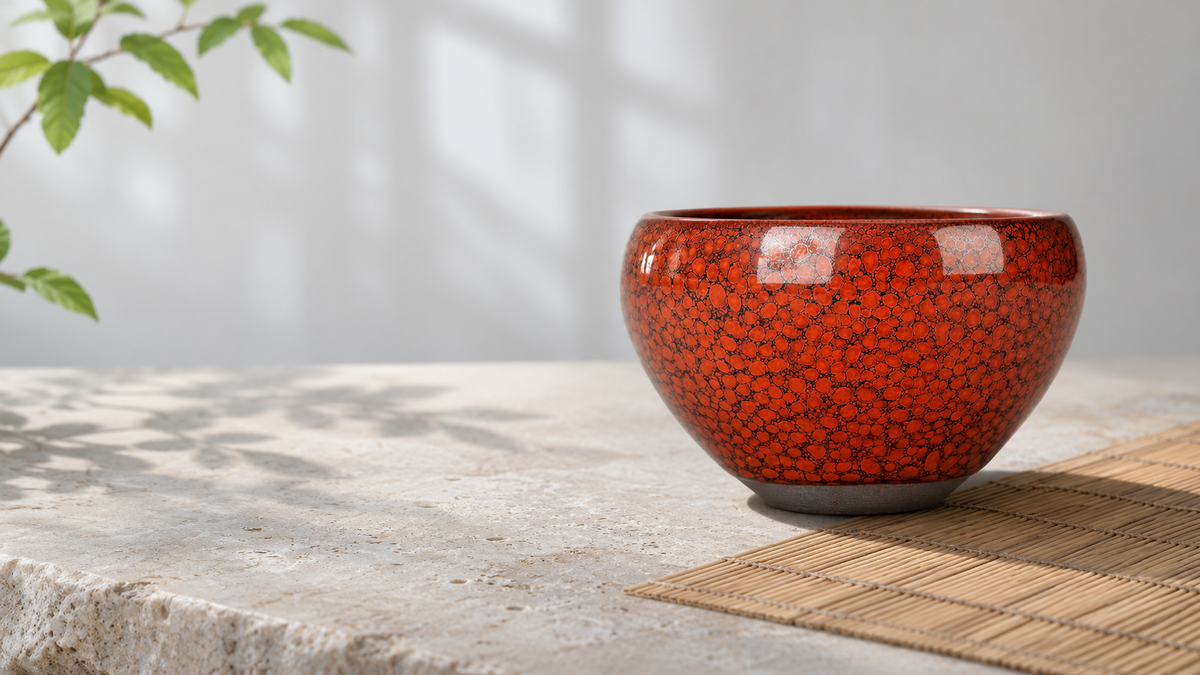
The Orange Flow Tenmoku Ceramic Teacup Bowl illustrates why category names and scale need to be read together. It has a rounded, handleless bowl form, an orange-red patterned exterior and a dark foot. Its current product page lists an approximate capacity of 140 mL, diameter of 9.5 cm and interior depth of 6 cm. These are listing figures, not measurements taken during this article’s preparation.

The useful buying question is whether its stated serving size and rounded shape suit the tea you intend to drink. It is not whether the bowl resembles dinnerware when photographed alone. If you want to prepare matcha with a whisk, the listing measurements do not by themselves establish suitability; internal working space and the intended method still need confirmation.
Likewise, this example is not a recommendation to serve rice in Orange Flow. The article compares categories without changing the product’s intended role. Its page advises against microwave use and direct stovetop heat. Do not assume a bowl-shaped cup can reheat food simply because a different ceramic rice bowl can. Packaging, manufacturing details and any use beyond the listing need separate confirmation.

For other drinking shapes, compare the Jianzhan and Tenmoku tea cups. Use the product details to choose a tea vessel, rather than treating every item in a bowl-named collection as suitable for every bowl-related task.
Can You Use One Bowl for Both Tea and Rice?
Sometimes a vessel can serve more than one purpose, but the shared name is not evidence that a specific product does. Confirm the maker’s intended uses and any relevant care limitations. A food-contact claim alone does not settle capacity, temperature limits, whisk clearance or microwave compatibility. Those are different questions and need different answers.
Even when both uses are supported, consider convenience. If the bowl is holding rice when you want tea with dinner, you still need another drinking vessel. If a strongly scented meal leaves an odor, you may prefer a separate tea bowl rather than carrying that scent into a delicate tea session. This is a practical preference, not a claim that every glaze absorbs food aromas.
For a first purchase, buying for one clearly stated job is usually easier to evaluate. Choose a tea drinking bowl for tea, a rice bowl for your meal portion, or a matcha bowl for your preparation method. Consider a dual-use piece only when the specific product information supports both uses and you are happy with the compromises.
Five Listing Checks Before You Order
- Identify the exact job. Is the bowl for drinking prepared tea, whisking matcha, serving a rice portion or holding a full meal?
- Separate capacity from dimensions. Ask whether capacity is brimful or usable, and whether a depth figure means interior depth or overall height.
- Look beyond the hero photograph. Request a clear rim, interior-base, side and foot view. Do not estimate scale from an unmeasured prop.
- Read the care limits. Confirm use-specific restrictions rather than transferring microwave, dishwasher or heat claims from another bowl.
- Check what is included. A pictured whisk, spoon, lid, tray or gift box may be a styling prop. Confirm the selected option and item list.
Keep the answers with the product link while comparing sellers. Two listings may use the same broad title while describing very different sizes. A concise set of confirmed facts is more useful than a long list of decorative adjectives or a claim that one bowl is perfect for every occasion.
Questions About Tea Bowls and Rice Bowls
Is a chawan always a matcha bowl?
No. The word can refer to a rice bowl or a tea bowl depending on context. In an English teaware shop it may be used specifically for matcha, but you should still read the intended use and dimensions. The label does not establish that every bowl has the same preparation space.
Are tea bowls always larger than rice bowls?
No. That comparison may describe some matcha bowls, but it does not cover every tea drinking vessel. A small bowl-shaped teacup can be much more compact. Compare the exact products and their intended activities rather than applying one size rule to all tea bowls.
Can a rice bowl be used to whisk matcha?
Possibly, if the specific vessel is suitable for that use and has enough accessible internal space. Do not decide from its name or capacity alone. A narrow base, crowded opening or unsuitable surface can make the task awkward. A bowl intended for matcha is the clearer starting point when buying specifically for whisking.
Does Tenmoku mean the bowl was made in Japan?
No. Do not use a style name as proof of where a modern product was made. Check the seller’s origin information separately. The same caution applies to handmade claims, glaze-process descriptions and decorative material names.
Choose the Bowl Around Its Job
For a tea drinking bowl, prioritize the pour, rim and grip. For a matcha bowl, add the working space required by your whisk. For rice, prioritize the meal portion and how comfortably you lift the bowl. Orange Flow belongs here as a small tea drinking example: judge it on that role and its stated product details, not on the assumption that similar-looking bowls must do the same work.
Share:
Aroma Cups vs Drinking Cups: Do You Need Both?
Tea Cup Foot Rings: Why Is the Base Unglazed?