

Is a matcha bowl lead free? You cannot answer that question from its color, price, country of origin, or the word “chawan” alone. Ask about the specific finished bowl, its intended food use, and the evidence behind the seller's wording. Then check whether its interior actually suits your whisk and preparation method. A bowl can look beautiful on a tea shelf without being the right tool for your daily matcha.
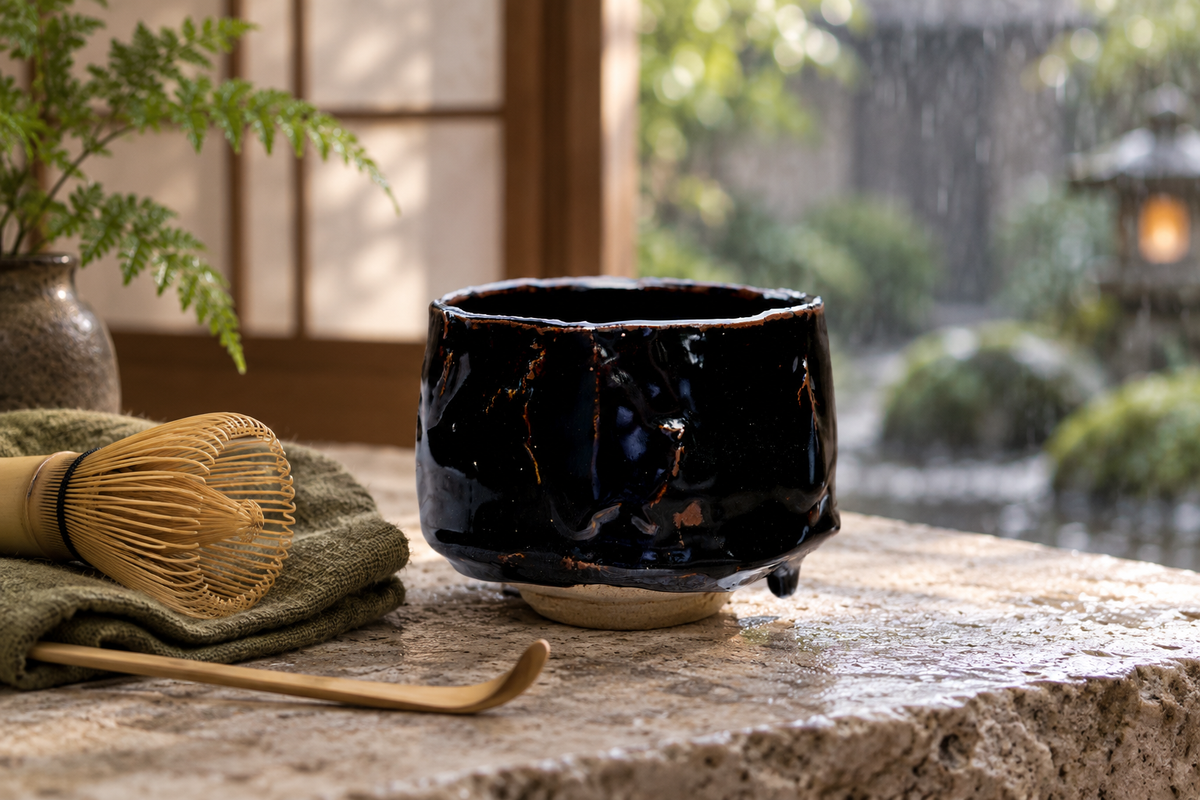
This guide separates three decisions that are often mixed together: understanding a lead-free claim, choosing a practical whisking shape, and buying a piece you can care for confidently. It does not certify any pictured product as lead free. The product photographs below illustrate shape and finish, not laboratory results.
Start with the finished bowl, not the glaze name
“Matcha bowl,” “tea bowl,” and “tenmoku” describe uses or styles; they are not interchangeable safety reports. When comparing two listings, write down exactly what each seller promises. Does the listing describe a glaze ingredient, the whole finished vessel, or a test result? A broad statement about a collection does not automatically explain a particular finish or production batch.
The FDA explains that some ceramic foodwares can release lead into food and that decorative pottery should not be treated as tableware. Its guidance also addresses misleading lead-free labeling in traditional pottery. Read the agency's questions and answers on lead-glazed pottery for the underlying concern. This is general background, not an assessment of a specific matcha bowl.
For shopping purposes, keep the question narrow: “What information supports this particular bowl's intended use for preparing and drinking matcha?” That gives the seller something concrete to answer. It is more useful than asking whether every dark ceramic, handmade vessel, or imported cup is safe.
What to ask before buying
A helpful inquiry identifies the product, finish, and intended use. If several colors share a listing, include the exact option. Explain whether you want to whisk directly in the bowl or simply drink matcha prepared elsewhere. These are different fit requirements even when the same food-contact questions apply.
- Is this exact finished piece intended for preparing and serving drinks, rather than decoration?
- What does “lead free” mean in this listing, and what documentation supports that wording?
- If a test report is available, which product, finish, sample, and date does it cover?
- Does the report address release into a test solution, total material composition, or something else?
- What are the interior opening, usable base width, and interior depth?
- Are there restrictions on hot water, dishwashers, microwaves, soaking, or abrasive cleaning?
You do not need to become a laboratory specialist to ask these questions. You need enough information to connect the answer to the item you will receive. If a report names a different product or provides no identifying detail, ask for clarification before treating it as relevant evidence. An attractive certificate image without readable scope is not a useful comparison tool.
Read common claims without overinterpreting them
| Listing information | What it helps you understand | What still needs checking |
|---|---|---|
| Lead-free glaze | The seller's statement about glaze formulation | Evidence for the finished bowl and exact finish |
| Food-use statement | The intended use described by the seller | Supporting information and any use restrictions |
| Laboratory report | Results for the identified sample and method | Whether sample, finish, date, and scope match your purchase |
| Handmade or high-fired | A production description | Do not substitute these words for product-specific evidence |
| 200 ml capacity | A stated volume for comparing size | Whisk clearance, comfortable fill level, and interior geometry |
| Decorative use only | The piece is not being offered as foodware | Choose a different vessel for preparing or drinking matcha |
Use this table to organize questions, not to assign a safety score. Missing documentation is a reason to ask or choose another clearly documented item; it is not proof that a particular bowl contains lead. Equally, a reassuring product name is not proof of the opposite.
Why a matcha bowl needs more than enough capacity
Once the food-use questions are answered, consider the mechanics of preparation. A bamboo whisk needs working room inside the vessel. The opening diameter alone does not tell you how wide the bottom is, whether the walls curve inward, or whether your hand can move comfortably above the rim.
Compare the bowl with the whisk you actually own. Imagine its tines moving across the interior without being forced against steep sides. Look for an interior photograph taken from above and another that shows the wall-to-base transition. If the only picture is a dramatic side view, request a clearer view instead of guessing.
Capacity is another common source of confusion. A stated volume is not necessarily the amount you can comfortably whisk. You need room above the liquid for movement, and the listing may not specify whether its measurement is to the brim. Rather than prescribing one universal size, compare your normal preparation volume, whisk size, and preferred grip with the product's measurements.
A small tasting cup can be useful for sipping a prepared drink without being suitable for whisking it. Conversely, a vessel with a wide opening may still have an interior shape that does not suit your technique. Keeping “preparation vessel” and “serving cup” separate prevents a disappointing purchase.
A real product example: check the interior, not just the silhouette
The Black Glaze Handmade Tea Cup is listed with a 200 ml capacity, an 11.5 cm interior opening, and an 8.5 cm interior depth. The depth is measured inside the cup; it is not a claim about overall exterior height. Its irregular black-and-brown surface is visible in the actual product photographs.

Those figures provide a starting point for fit, not a guarantee that every bamboo whisk will work inside it. Compare its interior photographs with your equipment and ask about the usable base if you cannot judge it clearly. This guide does not provide a product-specific lead test report, and the photograph should not be read as a lead-free certification.

If your main goal is direct whisking, begin with our matcha bowl buying guide. If you mainly want a vessel for serving prepared tea, the broader tea bowl guide helps separate shape, size, and handling preferences. Choose the use first and the finish second.
Buying a vintage bowl or an unfamiliar handmade piece
A secondhand bowl often comes with a story but little documentation. A maker's mark, age estimate, or country label may help identify it, yet none answers every food-use question. Keep the provenance and the intended use as separate entries in your notes. If the seller cannot establish that it is appropriate foodware, use a different documented bowl for drinks.
Inspect the rim, interior, foot, and any repaired areas in clear light. A photograph can help you notice a chip or repair but cannot determine chemical composition. Do not treat an apparently clean surface as a test result. If the condition is uncertain, pause use and ask the maker or a qualified ceramics-testing service what assessment is appropriate.
A collector and a daily matcha drinker may reasonably choose different pieces. Someone buying for display can prioritize age, decoration, or a distinctive profile. Someone buying for daily preparation needs clear food-use information, practical dimensions, and usable care instructions. Neither choice requires turning an uncertain antique into a daily drinking vessel.
Do not turn a home check into a certification
A home observation answers only the question it can actually measure. Looking at the glaze, checking whether water beads on it, or noting that tea tastes normal does not establish whether the bowl releases lead. Likewise, an informal vinegar soak is not a substitute for a documented laboratory method and may be contrary to the maker's care guidance.
If you are considering a home screening kit, check its stated surface compatibility, instructions, and limitations. Do not treat a negative screen as blanket approval for repeated food use. When you need evidence about a finished vessel, ask a qualified laboratory which method addresses that question and how the result should be interpreted.
The FDA's ceramicware lead guidance discusses testing and categories. A consumer should not select a numerical threshold from a different vessel category and declare a matcha bowl compliant. Ask the report provider to explain the applicable scope instead.
Care and storage after purchase
Keep the maker's instructions with your order information. They should guide cleaning, temperature changes, and appliance use. If microwave or dishwasher suitability is not stated, ask rather than assuming that a ceramic vessel tolerates either. Lead-related evidence and appliance compatibility are different questions.
For routine handling, use the bowl gently, avoid knocking its rim against the sink, and let it dry before storing it. Do not use abrasive tools to try to remove a suspicious surface layer. If a new chip, loose fragment, or repair changes the food-contact surface, stop using the piece for drinks while you seek appropriate advice.
Keep your whisk and bowl inspection separate. A whisk that catches or feels cramped may indicate a shape or technique problem; that experience does not diagnose the glaze. Similarly, a comfortable whisking motion says nothing about a lead-free claim. Recording these observations separately makes a seller inquiry much easier to resolve.
Choosing a matcha gift without guessing
For a gift, start by asking how the recipient prepares matcha. A person who whisks in a dedicated bowl may appreciate a serving cup, but that is a different gift from a replacement preparation bowl. Someone just starting may already own a whisk with a particular head size. Knowing that detail is more useful than choosing the largest-looking vessel in a photograph.
Check the included items line by line. A picture showing a whisk, scoop, cloth, or tray does not mean those accessories are included. Our generated header is a styled scene, while the photographs within this article are actual product views. Consult the individual listing for what is sold, and do not use the header to infer a bundle.
When browsing the gift boxes collection, verify the selected variant's contents and intended role. Include care information with the gift and keep any relevant documentation accessible. A clear description of what the recipient is receiving is more helpful than an unsupported promise about universal suitability.
A short checklist for your final decision
- Identify the exact bowl and finish you intend to order.
- Confirm intended food use and clarify the wording of any lead-free claim.
- Match available supporting documents to that product rather than a generic collection.
- Compare your whisk with the interior opening, base, and depth.
- Confirm comfortable working capacity rather than relying only on a brim volume.
- Review condition, care restrictions, and included accessories.
- Keep the order details and instructions for future reference.
Frequently asked questions
Does a black or tenmoku-style glaze mean a matcha bowl contains lead?
No conclusion about lead content can be made from that visual description alone. Ask for information about the specific finished piece. Neither a dark appearance nor a pale appearance establishes food-use suitability.
Can I whisk matcha in any tea cup?
Not comfortably in every cup. A narrow opening, small base, or awkward wall shape may restrict your whisk. Compare the interior geometry and your preparation method before choosing a cup for that task.
Does this article certify the featured cup as lead free?
No. It uses the store's real photographs and listed dimensions to explain what to compare. Product-specific food-use questions and supporting evidence should be checked separately before purchase.
What if the seller cannot answer my questions?
Choose an alternative with clearer documentation and dimensions rather than filling the gaps with assumptions. For a daily matcha routine, the most useful purchase is one whose intended use, physical fit, and care requirements you understand.
Share:
Is a Tea Bowl Lead Free? A Practical Buying Checklist
Small Tea Cups for Everyday Use: Size, Serving, and Care