

The small hole in many teapot lids is an air vent. As liquid leaves through the spout, air needs a way to enter the body. A vent can help that exchange happen without the interrupted, gulping flow that occurs when air and water compete for the same restricted passage. Its job is practical, but its presence is not a certificate of quality.
Not every teapot has an obvious hole in the same place. Some admit air through another opening or through the relationship between lid and body. A photograph that does not show a vent is therefore not enough to diagnose a defective pot. Before buying or changing anything, identify how the exact vessel is designed to work.
Why air needs to replace the tea leaving the pot
Imagine liquid leaving an enclosed container. If no air can enter to take its place, the flow becomes restricted. In a conventional teapot, a small opening can admit air while the spout carries the infusion outward. The result depends on the whole arrangement, including the spout, filter, fill level and lid fit. A vent is one component, not an independent pouring system.
This is why a narrow hole should not be confused with the leaf-retaining holes inside the body near the spout. Those openings have different locations and roles. The internal outlet lets liquid pass toward the spout while retaining some leaves; the lid vent provides an air path. A product photograph taken from the outside often cannot show both.
A vent hole is not a steam whistle
A brewing teapot is not a sealed pressure vessel and is not a kettle. Its lid hole should not be treated like the whistle on a stovetop kettle. Do not put a ceramic brewing pot on a burner because it has a vent, and do not infer direct-heat suitability from the presence of a handle, spout or thick-looking wall.
Use a separate appliance intended for heating water and follow the teapot's own care restrictions. The products discussed here are presented as brewing vessels, not water-boiling equipment. Their decorative surfaces and names do not establish flame, induction, oven or microwave compatibility.
What you can and cannot judge from the hole
| Observation | Reasonable next step | Unsupported conclusion |
|---|---|---|
| A visible opening in the lid | Ask whether it is the designed air vent | The pot is handmade or valuable |
| No opening visible in the photo | Request a top view and ask about airflow | The pot cannot pour |
| Flow slows during use | Check leaves and outlet as well as the vent | The vent is definitely the only cause |
| Lid moves while tilting | Stop and assess lid fit and grip | A tighter seal is always better |
| A dark mark beside the opening | Inspect the cool clean lid | The mark proves a crack or a special firing method |
| A seller demonstrates an air-lock trick | Evaluate ordinary pouring separately | The trick proves authenticity or food safety |
The useful purchase question is whether the pot pours a manageable amount into your receiving vessel with comfortable handling. An impressive close-up or trick does not answer that question. A plain video showing a normal fill and a normal pour is more relevant.
The Stone Texture pot as an example of what photos show
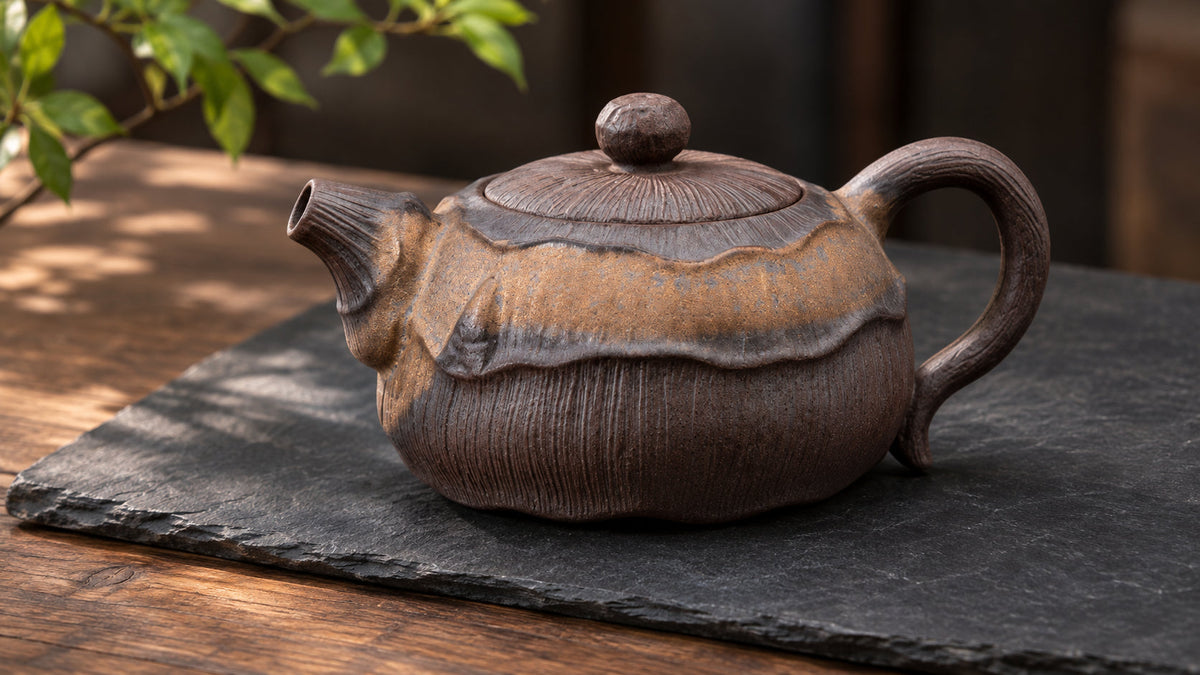
The Stone Texture Brown Ceramic Teapot has a broad rounded body, a loop handle, a short spout and a separate lid. Its dark brown texture and contrasting ochre-colored band are visible features. They make it a useful example for locating the parts of a brewing pot without assigning an unverified process to the finish.

The main product photograph does not provide a clear close inspection of every air opening. This article does not claim a particular vent diameter or position for that product. If vent placement matters to your grip, ask for an overhead lid photograph or a short normal-pouring video before ordering. Do not turn an illustrative header into evidence of a feature that the catalog view cannot establish.
Also ask about the current working capacity, outlet and cleaning access if those details are important to your routine. The external silhouette cannot confirm them. Check the selected product rather than relying on a different teapot with a similar body shape.
Why you should not block the hole during hot pouring
Videos sometimes show a person covering a vent to interrupt the stream. That can illustrate airflow in a particular pot, but it also places a finger near hot ceramic and escaping vapor. It is not a necessary step in making tea, and it is not a safe performance test to copy casually with hot water.
Keep your normal grip away from the vent where possible. If the only grip you can manage covers an opening or places your hand in the path of vapor, reconsider whether that handle and lid arrangement suits you. A product you can hold comfortably is more useful than a product that requires a demonstration trick.
Do not seal a vent with tape, wax, glue or a makeshift plug. Do not enlarge it with a drill or metal tool. These changes can damage the ceramic, introduce unsuitable substances or interfere with the intended airflow. If the design seems faulty, stop using the pot and ask the seller about an appropriate remedy.
Check a new pot with cool water first
A modest cool-water check over a sink can reveal awkward handling without involving a hot infusion. Inspect the empty pot for visible damage. Seat the lid normally, add a moderate amount of water and pour into a stable receiving vessel with enough room. Watch where the stream lands and whether the lid shifts.
This is not an authenticity test or a laboratory assessment. It simply helps you decide whether the ordinary movement is manageable. Do not force an extreme tilt to empty the last drops, hang the pot from its lid, or invert it to imitate a video. A lid that shifts during a gentle pour is a reason to stop and assess the setup.
Use this opportunity to note the distance between the spout and receiving cup. An unnecessarily high pour makes aiming harder and can splash. Bring the receiving vessel closer while keeping both pieces stable. A controlled ordinary pour tells you more about daily usability than the longest or most dramatic stream.
When the pour becomes slow or uneven
A change during a tea session may come from leaves covering the outlet, a blocked strainer, an overfilled body or a change in the way you tilt the pot. It may also involve airflow. Avoid choosing the most interesting explanation before checking the simple ones.
Set the pot down safely and allow it to cool before inspecting parts. Empty the leaves and clean according to the product's care requirements. Then compare a modest water-only pour with the previous behavior. If the problem appears only with a particular tea, leaf size and expansion may be relevant. If it occurs with water as well, ask the seller about the pot rather than modifying it.
- Check that the lid is seated as intended.
- Keep a comfortable fill below the point where liquid reaches unwanted openings.
- Inspect the internal outlet and any removable strainer when cool.
- Check for residue around the vent without forcing a tool through it.
- Stop using a pot with cracks, unstable parts or unexplained leakage.
Cleaning the lid without damaging the opening
Small openings can collect residue, but aggressive scraping is not the answer. Follow the item's cleaning requirements and rinse accessible areas gently. Avoid abrasive tools or a sharp implement pushed through a narrow vent. An opening that looks uneven should not be reshaped at home simply to make it look more symmetrical.
Give the lid a secure place to dry separately from the body when practical. A lid perched on a wet rim can slide, while a closed damp pot traps moisture. Store the pieces so that the knob and rim are protected from knocks. Do not use a replacement lid merely because it seems to cover the opening; fit involves more than the apparent diameter.
Does a perfectly sealed lid mean a better teapot?
Not necessarily. A teapot needs an appropriate relationship between lid, airflow and pouring, not the tightest possible seal under every condition. A lid can fit comfortably without supporting an upside-down trick. Equally, a highly convincing trick does not establish how well the pot suits your hands or tea.
Do not use the vent as a shortcut for claims about age, origin, clay composition, food-contact testing or handmade status. Those questions require their own evidence. For shopping, prioritize a clear description, current photographs and straightforward answers about the exact item.
Ask for the photograph that answers your question
If you cannot identify an opening in the gallery, request a top view of the lid and a view of its underside when cool. Explain whether your concern is grip position, cleaning access or a change in pouring. Those are specific questions a seller can answer. Asking whether the hole proves the pot is good invites a vague response because several unrelated qualities have been bundled together.
For a pot already in use, a short description of the problem is equally useful: whether it happens with plain water or only with leaves, whether it began recently and whether the lid shifts. Do not dismantle, reshape or repair the pot to gather that information. Clear observations of normal behavior are enough to begin a useful conversation.
Choose for an ordinary session, not a demonstration
Before buying, ask how much brewed tea the pot is intended to deliver, how the outlet retains leaves and whether a normal pouring video is available. Check that your receiving cups or pitcher have sufficient space. A vent cannot compensate for a setup that overflows after one pour or for a handle that feels too cramped.
Compare other outlines in the ceramic teapot collection. For a broader purchase decision, our teapot selection article discusses size, material and handling.
The hole in a teapot lid has a straightforward role: it can provide an air path while tea leaves through the spout. The sensible response is to keep that path unobstructed and judge the complete pot in normal use. Comfortable handling and a predictable everyday pour matter more than turning a small opening into a claim the product evidence cannot support.
Share:
Gaiwan vs Teapot: Which Fits Your Tea Routine?