

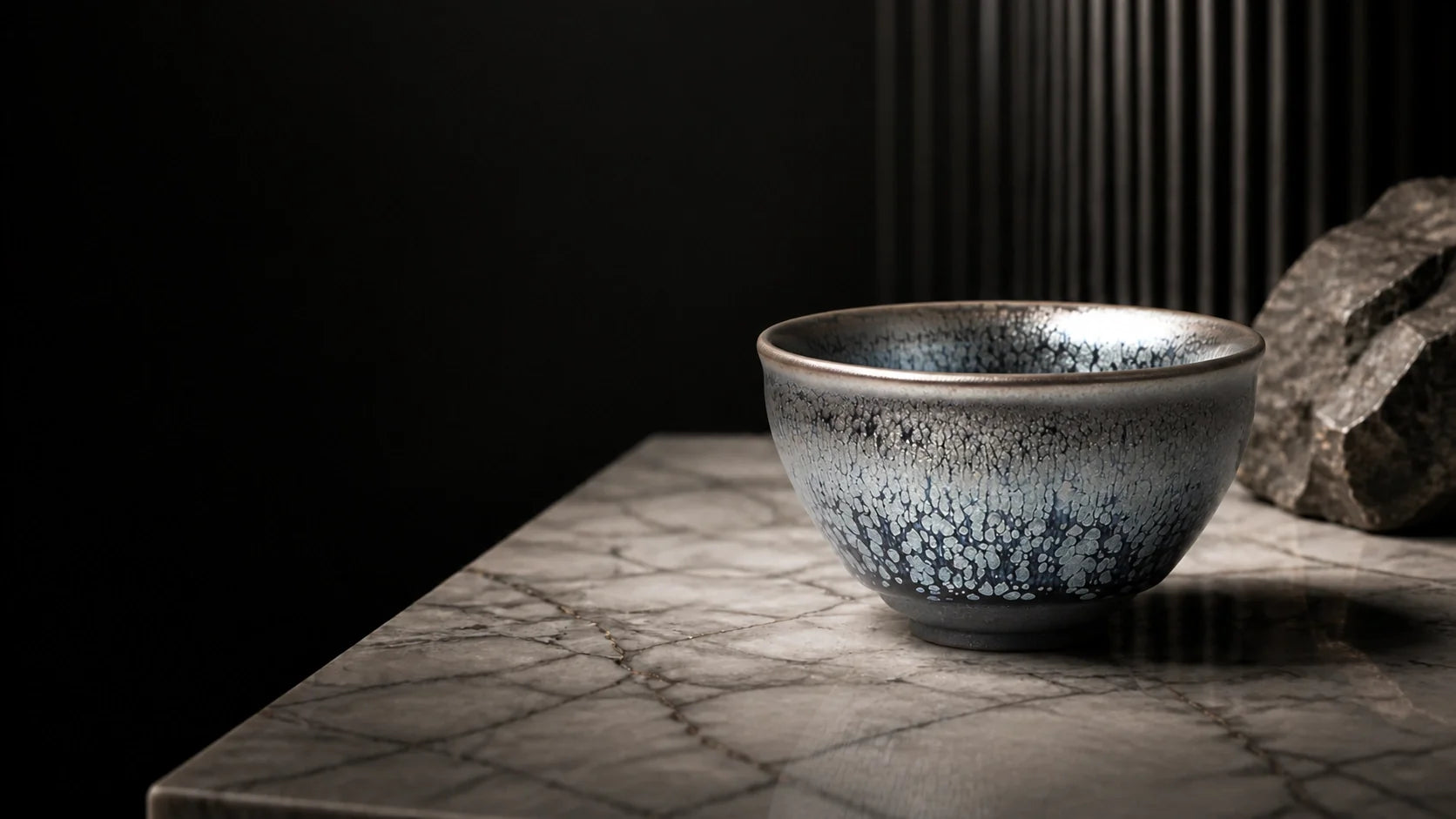
Among the classic Tenmoku glaze styles, Hare's Fur Tenmoku has one of the most recognizable appearances. Its surface features long, delicate streaks that flow down the bowl like strands of soft animal fur. The effect can appear silver, brown, golden, or blue depending on the glaze chemistry and lighting.
Unlike painted decoration, these lines form naturally during high-temperature firing. Iron-rich glaze moves across the bowl, separates, and crystallizes as the kiln cools. The potter can influence the result, but cannot reproduce every line exactly.
This combination of control and unpredictability gives Hare's Fur Tenmoku its lasting appeal. It connects modern tea drinkers with Song Dynasty ceramic traditions while still feeling elegant in contemporary homes.
What Is Hare's Fur Tenmoku?
Hare's Fur Tenmoku is an iron-rich glaze style known for elongated streaks running from the rim toward the lower part of a tea bowl.
The name comes from the visual similarity between these lines and the fine fur of a hare.
In Chinese ceramic history, this effect is strongly associated with Jian ware from Fujian Province. During the Song Dynasty, Jian kilns produced dark tea bowls for powdered tea. Some bowls developed striking vertical streaks through iron crystallization during firing.
In modern English-language ceramic discussions, the style is commonly called Hare's Fur Tenmoku. In Chinese contexts, it may be connected with the term, which refers to the hair-like glaze pattern.
The defining feature is not simply a dark background. It is the natural formation of long, directional iron-rich streaks within the glaze.
How Does Hare's Fur Tenmoku Form?
The glaze effect begins with iron-rich materials.
A typical Tenmoku glaze contains minerals that melt at high temperatures. During firing, iron oxide becomes mobile within the glaze layer. As heat changes and the bowl cools, iron-rich compounds can separate and move downward.
Gravity, glaze viscosity, bowl angle, kiln atmosphere, and cooling rate all influence the final pattern.
The result is a group of fine lines that seem to flow vertically across the surface.
The process involves several important variables:
-
Iron concentration
-
Glaze thickness
-
Clay body composition
-
Maximum firing temperature
-
Cooling rate
-
Kiln atmosphere
-
Position inside the kiln
Even small changes can alter the final appearance.
That is why two bowls made from the same recipe may still look noticeably different.
Why Do the Streaks Flow Downward?
The directional appearance of Hare's Fur glaze comes from the movement of molten glaze.
During high-temperature firing, the glaze becomes fluid. Iron-rich material can travel through the surface while gravity pulls the glaze downward.
As the glaze cools, the moving mineral structures become fixed in place.
This creates long streaks that often begin near the upper walls and continue toward the base.
The flow is influenced by the bowl's shape. Steeper walls may produce longer vertical movement, while broader forms may create more dispersed effects.
A successful Hare's Fur bowl therefore reflects both glaze chemistry and physical form.
Hare's Fur Tenmoku Compared With Other Tenmoku Glazes
Different Tenmoku glazes use similar iron-rich principles but create very different surfaces.
What This Comparison Means for Buyers
Hare's Fur Tenmoku offers a different visual experience from Oil Spot.
Oil Spot usually attracts attention through metallic contrast and circular crystal effects. Hare's Fur appears softer and more directional.
This makes Hare's Fur especially appealing for people who prefer traditional, understated aesthetics.
The bowl still has visual depth, but the pattern feels quieter and more natural.
Why Was Hare's Fur Important During the Song Dynasty?
The popularity of Hare's Fur bowls developed during a period when powdered tea was widely consumed in China.
Tea competitions were especially popular among elites and scholars. Participants judged the quality of whisked tea by looking at the foam and its appearance inside the bowl.
Dark Jian bowls provided excellent contrast with pale tea foam.
The flowing streaks also added visual refinement without distracting from the drink itself.
This balance between function and beauty helped Jian bowls gain status.
Hare's Fur patterns became one of the most characteristic glaze effects associated with this tradition.
Is Hare's Fur Tenmoku the Same as Jian Zhan?
The terms overlap, but they are not identical.
Jian Zhan refers to tea bowls associated with Jian ware traditions from Jianyang, Fujian Province.
Hare's Fur describes a specific glaze pattern.
Therefore:
-
A traditional Jian Zhan bowl can feature Hare's Fur glaze.
-
A modern Hare's Fur Tenmoku bowl may be made outside Jianyang.
-
Not every Jian Zhan bowl has a Hare's Fur pattern.
This distinction matters when reading product descriptions.
A seller may use "Hare's Fur Tenmoku" to describe the glaze appearance, while "Jian Zhan" refers more specifically to heritage, production tradition, or geographic connection.

What Makes a Good Hare's Fur Pattern?
Quality should not be judged only by the number of streaks.
A visually strong Hare's Fur bowl usually has:
-
Clear directional movement
-
Balanced streak distribution
-
Natural variation
-
Good contrast against the dark glaze
-
Smooth glaze integration
-
Comfortable bowl proportions
The pattern should feel like part of the glaze rather than surface decoration.
Some bowls have dense silver lines. Others show fewer brown or golden streaks.
Both can be beautiful.
Personal preference matters more than choosing a supposedly perfect pattern.
Why Handmade Variation Matters
Handmade Hare's Fur Tenmoku bowls are rarely identical.
This variation comes from several sources.
The potter may apply slightly different glaze thicknesses. The bowl may sit in a different kiln position. Cooling may happen at a slightly different speed.
These changes influence how the iron moves and crystallizes.
As a result, one bowl may show long bright streaks, while another may display shorter and softer lines.
For many tea lovers, this individuality is one of the main reasons to choose handmade ceramics.
The bowl feels less like a standardized object and more like a unique result of craft and fire.
How Does Lighting Change the Appearance?
Hare's Fur glaze can look very different under changing light.
In soft indoor light, the streaks may appear subtle and brown.
Under stronger natural light, metallic highlights can become more visible.
Some bowls reveal silver, gold, or blue tones at certain angles.
This makes the glaze especially interesting during daily use.
The appearance changes as you rotate the bowl or move it near a window.
For photographers and collectors, side lighting often shows the glaze structure more clearly than direct overhead light.
Is Hare's Fur Tenmoku Good for Daily Tea Drinking?
Yes, when the bowl is properly made with suitable materials.
Hare's Fur Tenmoku is not only decorative. Many bowls are designed for regular tea use.
The dark glaze works especially well with:
-
Matcha
-
Green tea
-
Oolong tea
-
Black tea
-
Herbal tea
A wider bowl can be useful for whisked tea, while a smaller cup-shaped form may suit everyday drinking.
The glaze pattern does not determine function by itself.
Shape, capacity, rim comfort, weight, and food-contact suitability are equally important.
How to Choose a Hare's Fur Tenmoku Bowl
When comparing bowls, start with practical factors.
Check the Bowl Size
Choose a size that matches your drinking habits.
Large bowls may work better for matcha or slow tea sessions.
Smaller bowls feel more suitable for concentrated tea drinking.
Look at the Glaze Pattern
Choose a pattern that appeals to you personally.
Do not assume denser streaks always mean better quality.
Consider the Shape
A stable foot and comfortable rim improve everyday usability.
Check the Product Description
Look for information about:
-
Handmade production
-
Materials
-
Firing method
-
Dimensions
-
Food-contact suitability
-
Natural variation
Clear product information usually reflects better quality control and transparency.
Hare's Fur Tenmoku vs Oil Spot Tenmoku
These two glaze styles are often compared because both have strong historical connections with Jian ware.
Which One Should You Choose?
Choose Hare's Fur if you prefer movement, subtle contrast, and historical simplicity.
Choose Oil Spot if you enjoy strong metallic reflections and more dramatic surfaces.
Both belong to the broader Tenmoku tradition.
Neither is automatically better.
The best choice depends on your visual taste and how you plan to use the bowl.
How to Care for Hare's Fur Tenmoku
Care is generally simple.
Wash the bowl with warm water and mild detergent when necessary.
Avoid abrasive scrubbers that may damage the surface.
Do not expose the bowl to extreme temperature changes.
Let it dry completely before storing.
If the bowl has a highly textured surface, rinse carefully so tea residue does not remain in small irregular areas.
Good care helps preserve both the glaze and the drinking experience.
Why Hare's Fur Tenmoku Still Appeals to Modern Buyers
Modern consumers often look for objects that feel personal and authentic.
Hare's Fur Tenmoku fits this preference well.
Its pattern comes from natural kiln processes rather than printed decoration.
The bowl connects everyday use with ceramic history.
It can also suit many interior styles, including:
-
Minimalist homes
-
Japanese-inspired spaces
-
Traditional tea rooms
-
Modern kitchens
-
Natural wood interiors
The dark glaze feels timeless, while the streaked pattern gives each piece personality.
Frequently Asked Questions
What creates the lines in Hare's Fur Tenmoku?
The lines form when iron-rich material moves through the molten glaze during high-temperature firing. Gravity, glaze viscosity, bowl shape, kiln atmosphere, and cooling speed all influence the movement. As the glaze cools, the iron-rich structures become fixed as visible streaks. The pattern is created through firing rather than painted onto the surface.
Is Hare's Fur Tenmoku rare?
Historical examples with excellent glaze quality can be rare and highly valued. Modern Hare's Fur Tenmoku is more widely available because contemporary potters can study traditional glaze chemistry and firing methods. However, high-quality handmade results still require skill. A successful firing with balanced streaks and attractive color variation is not guaranteed.
Can I use Hare's Fur Tenmoku every day?
Yes, provided the bowl uses appropriate food-contact materials and is designed for functional use. Many people use Hare's Fur bowls for matcha, green tea, oolong, and black tea. Choose a comfortable size and shape, then follow the maker's care instructions. Everyday use can make the bowl feel more personal over time.
Conclusion
Hare's Fur Tenmoku remains one of the most enduring glaze styles because it combines history, natural variation, and practical beauty.
Its long iron-rich streaks create movement without overwhelming the bowl. The pattern reflects kiln chemistry, gravity, cooling, and the potter's experience.
From Song Dynasty Jian ware to modern handmade tea bowls, the style has survived because it feels both ancient and contemporary.
For tea lovers who prefer subtle craftsmanship over dramatic decoration, Hare's Fur Tenmoku offers a particularly meaningful choice.
Share:
What Makes Oil Spot Tenmoku Glaze So Special?
What Is Tea Ceremony? A Beginner’s Guide to Meaningful Tea Rituals