

A tea bowl is a handleless vessel made for preparing, serving, or drinking tea. It may look like a broad cup, but its open rim, rounded interior, and the way it rests in your hands shape the experience. Some tea bowls are used for whisked powdered tea; others hold a modest pour of brewed tea. The phrase describes a form and a purpose, not one universal size, country of origin, or glaze.
If you have searched for “what is a tea bowl,” you may have encountered chawan, Jian Zhan, tenmoku, and ordinary teacups in the same results. Those names overlap, but they are not interchangeable. This guide explains the differences in plain language, shows what to inspect before buying, and offers a simple way to decide whether a bowl suits your own tea routine.
What makes a vessel a tea bowl?
In everyday use, a tea bowl is generally an open, handleless drinking vessel with a visible interior. You lift it with one or both hands rather than by a handle. The opening gives you a clear view of the tea surface and makes it easy to notice the glaze, the liquid’s color, and the shape of the rim. A small bowl may work for individual servings of loose-leaf tea. A wider, roomier one can leave space for whisking powdered tea. The intended use matters more than the name printed on a product tag.
Look at three physical features together. First, the rim should be comfortable to drink from and free of rough or chipped areas. Second, the wall and base should feel stable when the bowl is filled, not merely when it is empty. Third, the interior should have enough room for your preferred way of making tea. A vessel can be beautiful yet awkward if its rim is too wide for your grip, its foot is unstable on your tray, or its capacity does not match your serving size.
“Tea bowl” is also a useful umbrella term. A seller may call the same small, open vessel a tea cup, a teacup bowl, or a tea bowl. That is not automatically a problem. Judge the dimensions, photographs, and intended use rather than assuming that the title alone tells you how it will feel in hand.
Tea bowl, teacup, and matcha bowl: what is the difference?
A teacup is a broad category: it can have a handle or not, and it can be tall, narrow, or shallow. A tea bowl normally emphasizes an open shape that can be cradled. A matcha bowl is a tea bowl chosen for preparing and drinking whisked powdered tea. It typically offers room to move a whisk, but there is no single mandatory profile. You can sometimes drink brewed tea from a matcha bowl or whisk matcha in another sufficiently roomy bowl; the practical question is whether the shape works for the task.
| Vessel | Typical shape | Useful for | Check before buying |
|---|---|---|---|
| Tea bowl | Open, handleless, often easy to cradle | An individual serving or a deliberate tea ritual | Rim comfort, capacity, foot stability, and intended use |
| Everyday teacup | May be handled or handleless; shape varies | Frequent single servings | Comfort, grip, and the amount you normally pour |
| Matcha bowl | Usually wide enough for whisk movement | Whisking and drinking powdered tea | Working space for your whisk and easy access to the interior |
| Jian Zhan / tenmoku-style bowl | Handleless ceramic form with a visually prominent glaze | Tea drinking and appreciation of glaze and form | Actual dimensions, finish, product guidance, and photos |
These descriptions are guides, not strict rules. A particular item may fit more than one row. If you already own a whisk, compare its movement with the bowl’s usable interior rather than judging by overall diameter alone. If you usually pour a small amount of hot tea, test whether the bowl is comfortable to hold at that fill level. Do not assume that a photographed bowl is matcha-ready simply because it looks wide from above.
Where do Jian Zhan and tenmoku fit?
Jian Zhan is associated with historical Jian ware from China. The Metropolitan Museum of Art catalogs Song-dynasty Jian tea bowls with dark, iron-rich glazes, including the well-known hare’s-fur appearance. The museum also notes that Chinese bowls of this type were prized in Japan and influenced later production there. You can see an example in The Met’s Jian-ware tea bowl record. This history helps explain why searches for Chinese Jian Zhan and Japanese tenmoku may lead to related, but not identical, vessels.
For a modern buyer, the historical connection does not prove the origin, date, or technique of any particular retail piece. A contemporary bowl may be described as tenmoku-style because of its shape or glaze. If provenance, kiln, maker, or firing method matters to you, ask for documented details on that specific item. Avoid treating a dramatic glaze pattern or an attractive product story as proof of antique status.
Glaze is part of the experience, but it is not a guarantee that tea will taste better. A dark interior can make highlights in the liquid and surface pattern stand out. A lighter interior may make the tea’s color easier to judge. These are visual preferences. The tea itself, water, temperature, brewing time, and cleanliness of your vessels have a more direct role in what you drink.
How does the shape change the way you drink?
The first difference you notice is usually how the rim meets your lips. A smooth, evenly finished rim feels reassuring when the bowl is lifted often. A broad opening lets aroma rise freely and gives you a view into the bowl, but it can also expose more tea to the air. A narrower opening may feel easier to carry with one hand. Neither is universally better; choose according to the tea, serving style, and how slowly you like to drink.
Depth matters too. A shallower bowl can show its interior glaze beautifully and make cleaning simple. A deeper profile may feel more contained while carrying a full serving. The base or foot affects stability: a bowl that sits securely on your tray is more pleasant to use than one you must constantly correct. If a seller lists a diameter, remember that outside diameter is not the same as the usable width inside. Photographs from above and from the side together help you understand the shape.
Capacity is the most practical specification, but it needs context. The stated maximum may be measured close to the rim, while a comfortable drinking fill is lower. If your teapot makes several small pours, a modest bowl may be enough. If you want to prepare powdered tea in one vessel, you may value more working space. Consider your usual serving amount first, then compare it with the listed capacity. Do not buy a large bowl just because the image makes it look impressive.
How to choose a tea bowl in six checks
- Start with the tea you actually make. Loose-leaf tea served from a pot, matcha whisked in the bowl, and an occasional display piece create different requirements. Write down the primary use before comparing colors.
- Confirm the dimensions. Look for capacity, width, and height where available. If an important measurement is missing, ask the shop before ordering. Photos alone do not establish scale.
- Study the rim and foot. Examine close-up and side views for a smooth drinking edge and a base that appears stable. Ask for another view if the listing omits one.
- Choose a glaze you will enjoy seeing regularly. A vivid pattern is exciting, but so is a quiet finish that works with your daily teaware. Hand-finished patterns can vary between pieces; check the seller’s description of variation.
- Read care and use guidance. Do not assume dishwasher, microwave, stovetop, or oven suitability. Follow the instructions for the specific piece and ask if anything is unclear.
- Check the complete purchase terms. Review shipping estimates, the return window, and what you would need to do if an item arrived damaged. Make this check before you place a gift order with a fixed date.
These checks keep the decision grounded in use rather than marketing language. A lower-priced bowl that feels right in your hand may serve you better than a costly one selected only from a close-up glaze photograph. Likewise, a handmade appearance alone cannot tell you how much tea a bowl holds or how it should be cleaned. The product page must answer those practical questions.
Examples from the ARTTEACUP collection
For a concrete example of a wide-rimmed form, the Orange Flow Tenmoku Ceramic Teacup Bowl is listed at approximately 140 mL, 9.5 cm in diameter, and 6 cm deep. Its orange-toned flowing glaze and product photographs let you compare the rim, side profile, and interior before deciding whether it suits an individual serving. These dimensions belong to this listing, not to tea bowls as a category.

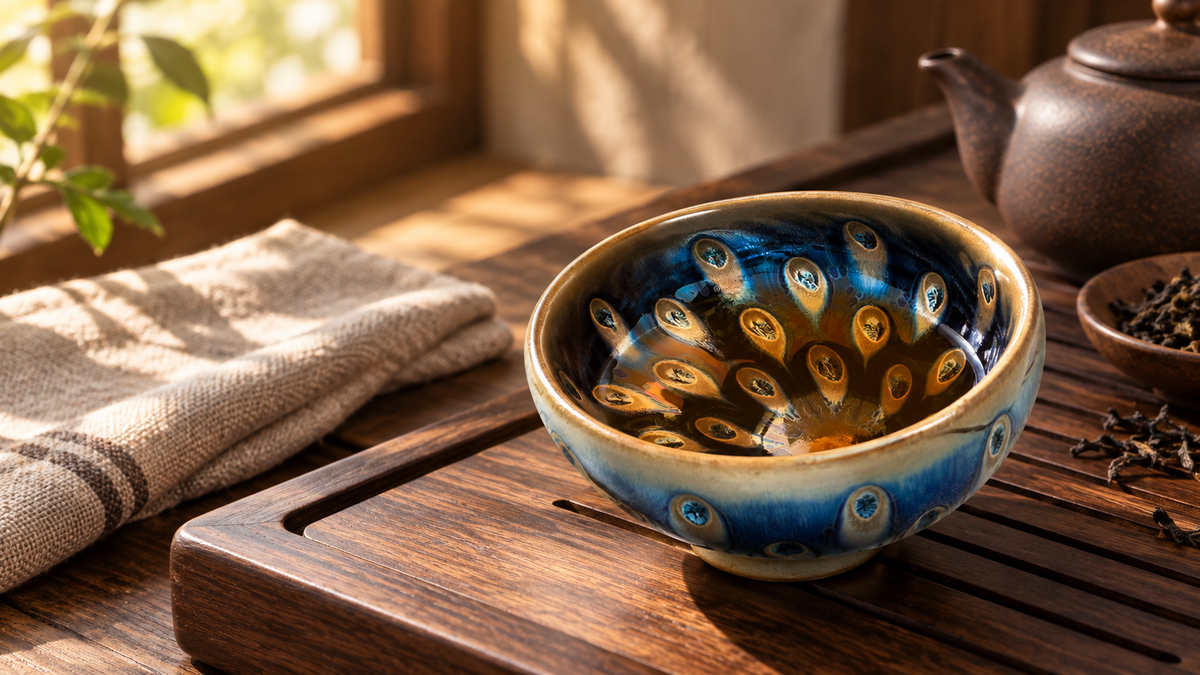
The Peacock Eyes Tenmoku Tea Cup shows a very different visual direction. Its open interior makes the blue peacock-eye pattern the focal point. Compare its photographs from several angles to judge the bowl profile as well as the decorative finish. If a precise capacity is essential for your tea method, ask for the current item’s measurement rather than guessing from an image.

If you prefer a quieter blue-toned form, compare the Blue Kirin Zen Jianzhan Teacup. The listing gives multiple close-up views but does not state a verified capacity or dimensions, so contact the store if those details will decide your purchase. You can browse the wider Jian Zhan collection to compare profiles rather than choosing solely by a single hero image.
Can a tea bowl be part of a daily routine?
Yes. A tea bowl does not require a formal ceremony. Set it on a stable surface, make a modest pour, and hold it where it feels secure. Pause long enough to notice the heat, aroma, and rim. If the bowl becomes too hot to handle comfortably, let the tea cool or reduce the fill level. Use care when passing a hot bowl to someone else, especially a guest unfamiliar with handleless teaware.
A simple routine also helps you learn whether the form suits you. For a week, use the same bowl with several teas you already know. Notice whether the opening feels convenient, whether you prefer holding it with one hand or two, and whether the serving amount matches the rest of your setup. You may find that one bowl becomes your daily cup while another is better for an unhurried session. That is a useful distinction, not a flaw in either piece.
When serving guests, explain that a tea bowl may be held around its lower wall or supported with both hands. Leave a comfortable margin below the rim when pouring. Place it on a tray or coaster with enough room around it for easy lifting. These small choices make an unfamiliar vessel feel inviting rather than precious or difficult.
Cleaning and storing a ceramic tea bowl
Care begins with the maker’s or seller’s instructions for the specific bowl. As a general, gentle routine, allow the vessel to cool, rinse it after use, clean it with a soft sponge if needed, and let it dry fully before storage. Avoid sudden temperature changes, rough scouring, and stacking pieces so tightly that their rims strike one another. A clean, dry shelf with enough space around the bowl helps protect the rim and glaze.
Do not assume that every ceramic bowl can go in a microwave or dishwasher. Body, glaze, decoration, and finishing details differ. The Orange Flow listing, for example, advises against direct stovetop heat and microwave use. Follow the instructions tied to your actual purchase; if none are given, ask the seller before trying a new cleaning method or appliance. A bowl used for drinking should be kept in good condition, and a chipped or damaged drinking edge deserves attention rather than continued casual use.
Common questions about tea bowls
Is a tea bowl the same as a matcha bowl?
Not always. A matcha bowl is a tea bowl selected for whisking powdered tea. The open shape and usable interior matter because a whisk needs room to move. A tea bowl intended mainly for small pours of brewed tea may be too narrow or shallow for comfortable whisking. Check the actual interior rather than relying on the listing name.
Does a tea bowl need to be handmade?
No. “Tea bowl” describes use and form, not a required manufacturing process. Handmade, hand-finished, and more uniform production methods can all produce usable vessels. If the making process is important to you, look for a specific, supportable description of the piece rather than assuming it from visible glaze variation.
Is Jian Zhan always an antique?
No. Jian Zhan has a historical tradition, and museums preserve early examples, but many pieces offered today are contemporary. A dark or patterned glaze does not by itself establish age, kiln, or provenance. Ask the seller for documentation if collectibility is central to your purchase.
How large should my first tea bowl be?
Begin with your usual serving. If you enjoy several small pours, seek a bowl that holds one comfortable pour with space left below the rim. If you plan to whisk matcha, prioritize usable interior width and depth. When a listing gives only a general photograph, ask for a measured capacity and a side view before you decide.
The takeaway
A tea bowl is a handleless vessel whose open form brings the tea, the rim, and the glaze into closer view. The best one for you is not defined by a fashionable name or a single photograph. Match the bowl to your tea method, confirm its dimensions and care instructions, and choose a shape you will enjoy holding. If you are ready to compare real examples, explore ARTTEACUP’s Jian Zhan tea bowls and cups, then open each product page to check the details that matter to you.
Share:
How to Choose Chinese Tea Gifts: A Practical Tea Culture Guide