

A built-in teapot strainer keeps leaves near the spout while you pour. A removable infuser holds them inside a basket that you can lift out when the steep is finished. Both can separate leaves from a drink, but they do not end brewing in the same way. That difference matters more than whether the filter is described as traditional, modern, or fine.
Choose around your usual tea and serving routine. If you empty a small pot into cups or a pitcher after each infusion, a fixed leaf guard may suit you. If you want to leave brewed tea in the pot while drinking gradually, a removable basket can make it easier to separate the wet leaves from the remaining liquid. Fit, cleaning access, and leaf size still need checking before you buy.
First identify what the seller means by strainer
Product names are not consistent. A listing may call a removable basket a built-in infuser simply because it sits inside the pot. Another may use strainer for holes formed in the ceramic body behind the spout. Look at the actual parts rather than treating those labels as interchangeable.
- Fixed ceramic holes: openings in the wall where tea enters the spout. The leaves remain loose in the pot.
- Fixed or fitted spout screen: a separate leaf guard at the outlet. Whether it can be removed depends on the design.
- Removable brewing basket: a container for the leaves, suspended inside the pot during steeping.
- External pouring strainer: a separate tool over a cup or pitcher that catches leaves during decanting.
An external strainer does not become an infuser unless it is also suitable for holding leaves in the brewing water. Likewise, a perforated spout does not isolate the leaves from tea left inside the pot. These are differences in function, not proof that one arrangement always produces a better drink.
Built-in strainers and removable infusers compared
| Buying check | Fixed holes or leaf guard | Removable brewing basket | External pouring strainer |
|---|---|---|---|
| Where the leaves sit | Loose inside the pot | Inside the basket | Usually loose in a separate brewer |
| Ending the steep | Decant the finished tea away from the leaves | Lift and drain the basket safely | Decant through it into a receiving vessel |
| Small leaf fragments | May pass through larger openings | Retention depends on mesh, holes, and seams | Can provide an additional filtering stage |
| Cleaning access | Check access to the inner spout wall | Check the basket base, seams, and rim | Check mesh and support surfaces |
| Fit requirement | Part of the pot or a model-specific fitting | Opening, depth, lid clearance, and water level | Stable support on the receiving vessel |
Your tea's leaf size changes the useful filter
Large intact leaves are easier to hold back with relatively open holes than fine broken leaf. A tea that looks tidy while dry may also contain smaller fragments at the bottom of its package. Compare the filter with the leaves you actually use, rather than with the largest leaf in a promotional photograph.
Rolled leaves can occupy more room after they hydrate. A narrow basket that appears spacious when empty may be crowded during brewing. Check usable space around the wet leaves and choose a basket that suits your normal batch, not just the pot's advertised volume. There is no universal basket size that fits every recipe.
A finer mesh can retain more visible fragments, but it also needs attention during rinsing. Do not assume that finer automatically means faster pouring, easier cleaning, or better flavor. For powdered tea or extremely fine sediment, an ordinary perforated basket may not deliver the clear drink you expect.
Think about what happens after the first cup
Imagine making tea for yourself, pouring one cup, and leaving the rest in the pot. With loose leaves behind a fixed strainer, the remaining liquid stays in contact with them. Pouring out the first cup has not stopped the steep for the tea you left behind.
A removable infuser offers a different sequence: brew, remove the basket, let it drain over the pot without unsafe handling, and place it on a suitable resting dish. The tea can then remain in the pot without the main leaf mass. Small particles that escaped the basket may still be present, so this is not a guarantee of identical flavor throughout a long afternoon.
If you normally empty the whole pot into a serving pitcher, the fixed arrangement may already work well. There is little reason to replace it merely because a removable accessory looks convenient. The useful question is whether you can separate your finished tea at the point you intend to serve it.
Check a removable basket at your normal water level
A basket must fit through the opening and sit securely, but those are only the first checks. Its lowest usable section must also reach the water when you brew your usual amount. A shallow basket in a tall pot may leave leaves above the water during a small batch.
Ask for the basket's external width, depth below its support rim, and the pot opening's internal width. Check whether the lid fits with the basket installed and after it has been removed. A basket marketed for mugs should not be assumed to fit a teapot's narrower neck.
For example, OXO describes its Tea Infuser Basket as shaped for a mug. That illustrates why a recognizable accessory name does not establish compatibility with your pot. Use the dimensions and supported vessel type, not a guess based on an online photo.
A Gold Flow teapot example: what photographs can confirm
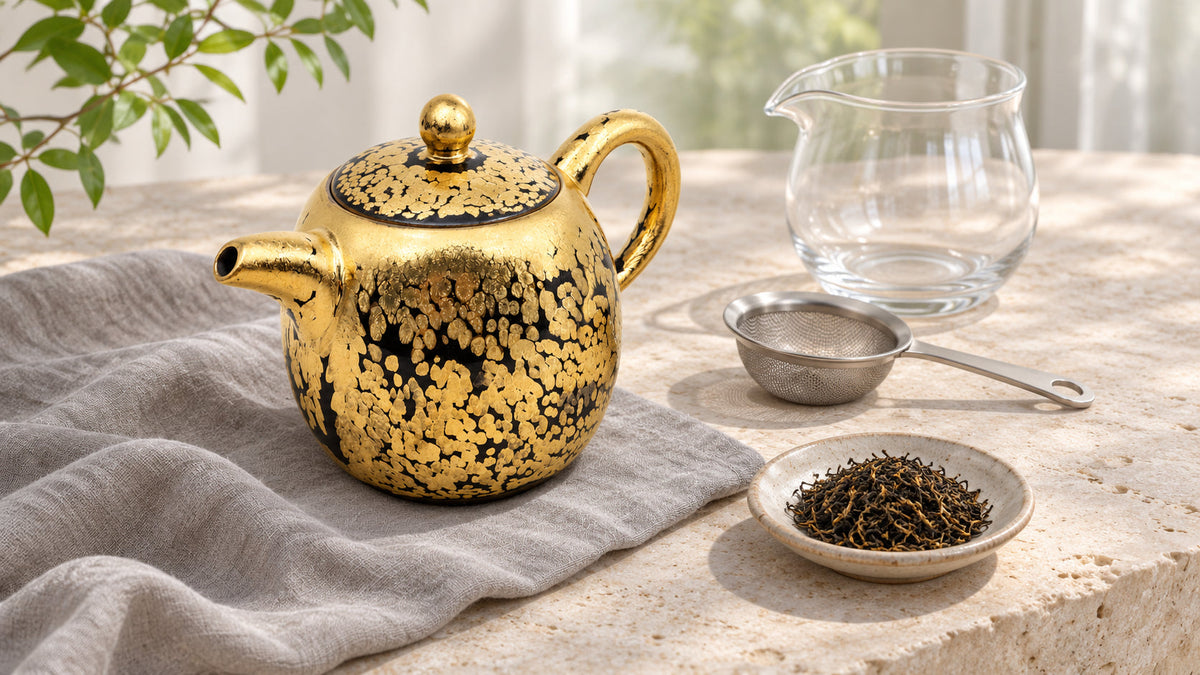
The Gold Flow Tenmoku Ceramic Teapot provides a useful example of the difference between choosing an exterior and verifying the filtering arrangement. Its real photographs show a rounded body, loop handle, short spout, matching lid, and contrasting golden-colored pattern over a dark surface. Those details can help you decide whether its appearance suits your tea table.

The same photographs do not establish the size or number of internal filtering holes, the fit of a third-party basket, or whether a removable infuser is supplied. This article therefore does not label Gold Flow as either a confirmed fixed-filter model or an infuser-equipped set. If a particular filtering method is essential to your purchase, obtain an inside view and confirm the included pieces before ordering.
The golden appearance is a color description, not a claim about precious-metal content. Likewise, no particular manufacturing duration, gift packaging, or heating compatibility follows from its appearance. Choose the visual design only after the practical details you need have been confirmed.

When an external strainer is the simpler addition
If you like your existing pot but occasional fragments reach the cup, an external strainer may solve the immediate problem without changing the brewer. Check that it rests securely over a suitable pitcher or cup and that you can pour without balancing several hot objects in your hands.
It is particularly worth considering when a replacement basket would require uncertain measurements or would prevent the lid from closing. You still need to decant the finished tea away from leaves left in the pot. Filtering while pouring does not change the brewing time of liquid that remains behind.
Allow for another item to rinse and store. An external tool is not automatically more convenient for every person, and it should not be assumed to come with a decorative teapot. The header scene uses separate serving props for illustration, not as a package-content photograph.
Cleaning: inspect the difficult corners before buying
A fixed ceramic screen has no basket to misplace, but access to its inner surface can be awkward through a small opening. Look for a clear photograph of the spout entrance and consider whether you can rinse away trapped leaves without pushing sharp objects through the holes.
A removable basket exposes more surfaces for cleaning outside the pot. Check the bottom, the seam where mesh meets its frame, and any folded edge that can hold leaf fragments. A wide opening helps you empty leaves; a narrow chamber may need more careful rinsing.
Let equipment cool sufficiently before handling, empty leaves into an appropriate waste container, and clean according to the maker's care information. Do not infer dishwasher compatibility from stainless steel or ceramic alone. Avoid forcing brushes or wire through a fixed screen, and do not use aggressive cleaning methods without checking the finish's care limits.
Three routines and the arrangement to consider
One person drinking a pot gradually
A correctly fitted removable basket is worth considering because you can lift the leaves out while leaving the tea in the pot. Put a resting dish nearby before brewing. Check that the basket reaches the water for your usual small batch and that removing it does not leave the lid unsupported.
Several small cups served together
Loose leaves with a suitable fixed guard can work when the complete infusion is decanted promptly. If fragments bother you, add an appropriate external strainer over a stable serving pitcher. Match the batch to the cups rather than leaving an oversized quantity on the leaves.
Frequent changes between different teas
Prioritize accessible surfaces and a cleaning routine you will actually follow. A removable basket may be convenient to empty, while a simple pot with accessible fixed holes may also suit you. Inspect the specific design rather than choosing solely from a material label or a promise of effortless cleaning.
Questions to ask before ordering
- Can I see the inside of the spout entrance with the lid removed?
- Are the filtering holes part of the ceramic body, or is there a separate screen?
- Is a removable brewing basket included in the selected option?
- What are the opening and basket dimensions, and does the lid close in both configurations?
- Will the basket reach my normal brewing water level?
- Which cleaning and heating limits apply to the pot, lid, and filter separately?
Keep the answers with the exact product option. A similar-looking pot from another seller is not evidence that the same basket or filter is present. When comparing the broader purchase, our teapot size, material, and pouring article covers the vessel beyond its filter. Check the current listing rather than assuming that a tea-brewing pot can also boil water.
Common questions about teapot filters
Does every teapot need an infuser?
No. Leaves can brew loose in a suitable pot and be separated during decanting. Whether that arrangement suits you depends on the outlet, leaf size, and your willingness to pour the finished batch away from the leaves.
Will a fixed strainer stop every leaf particle?
Not necessarily. Fragments smaller than its openings can pass through. Match your expectations to the actual holes and tea, and consider a suitable finer external strainer if you want another filtering stage.
Can I buy any replacement basket?
No. Check the support rim, opening, internal depth, lid clearance, and immersion at your working water level. A basket that drops into the opening is not automatically secure, practical, or compatible.
Do I need a basket for tea bags?
An intact tea bag already contains its leaves. A separate basket is not automatically needed; check that the bag fits and is easy to remove. Our tea bags in a teapot article addresses that different routine.
Choose the separation method before the finish
Start with the tea you drink, how much you brew, and whether you empty the pot promptly. Then compare filtering openings, basket fit, and cleaning access. A removable infuser is useful when its removal fits your serving routine; a fixed strainer is useful when decanting the batch already does that job.
Once those practical points are settled, compare the shapes and finishes in our teapot collection. For Gold Flow, confirm the internal filtering arrangement rather than selecting it on an assumed accessory. A well-matched purchase combines the appearance you enjoy with a brewing sequence you can use comfortably.
Share:
Tea Cups for Herbal Infusions: Choosing for Leaves and Flowers